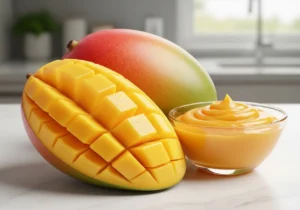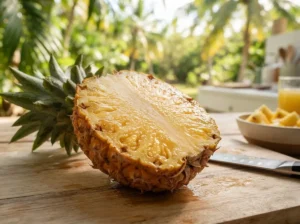
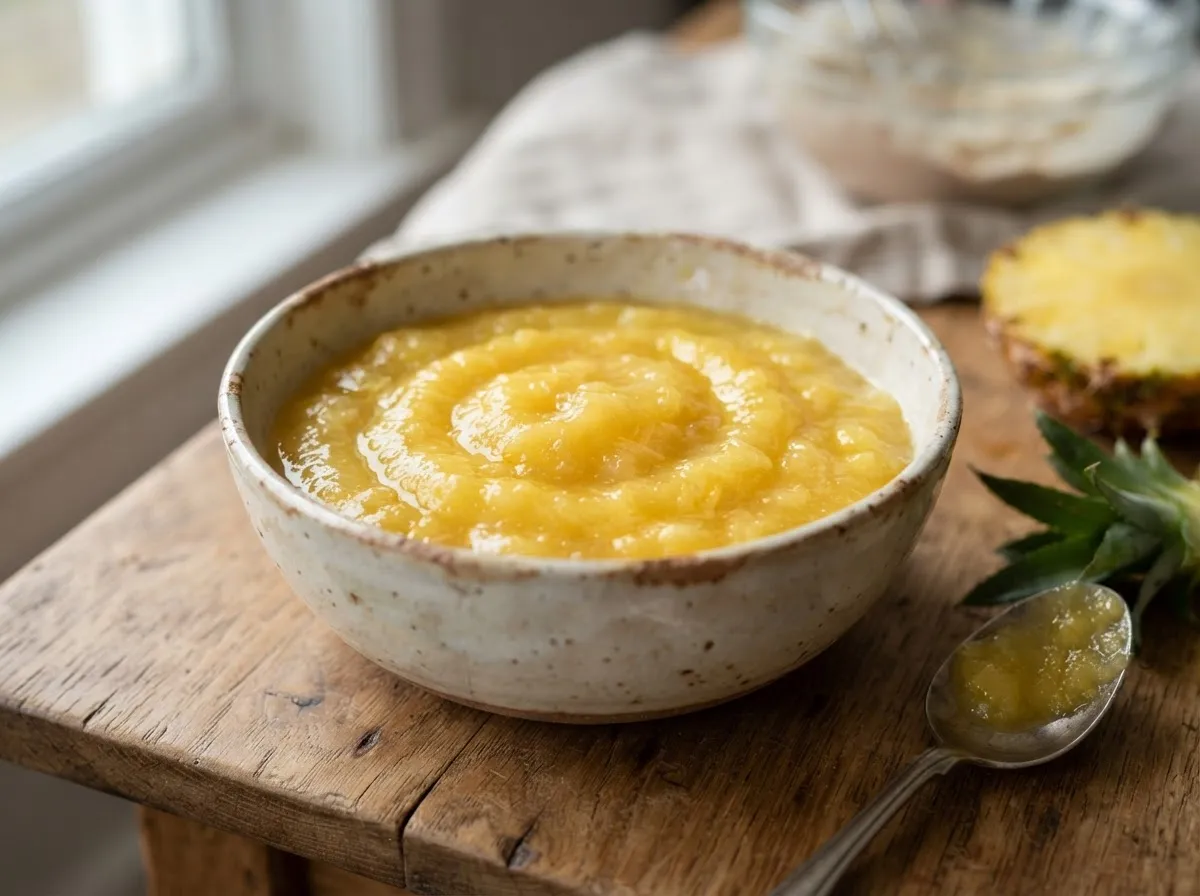
Pineapple puree for cake is the edible fraction of ripe fruit, which plants disintegrate and sieve without diluting it. Moreover, its role on the plant floor stays concrete: it delivers moisture, acidity and steady tropical flavor in every bake. Therefore, more baking manufacturers now choose it over fresh fruit or over canned pineapple in syrup. Besides, commercial interest follows that trend, since the US tropical fruit market approaches USD 5.26 billion (FreshFruitPortal.com, 2026).
Below, you will find what this ingredient is, how producers make it, where it applies and what to check first.
What pineapple puree for cake is and how producers make it
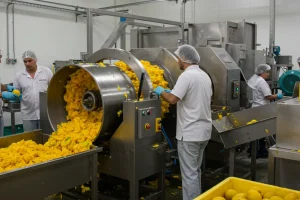
This natural product carries no added sugar and no preservatives, and it comes from pineapple picked at optimal ripeness. First, the plant receives and sorts the fruit; next, operators wash, pulp, refine and pasteurize it. Afterward, either aseptic filling or freezing stabilizes the product, and neither step alters its sensory profile. Consequently, your plant receives an ingredient that arrives ready to dose straight into the mixer.
Before buying, however, you should tell apart three presentations that purchase orders very often confuse:
- Single strength puree: it keeps the natural soluble solids of the fruit, without concentration or dilution. Besides, it adds body and full flavor.
NFC juice: it stays liquid and adds no pulp; therefore, it hydrates the batter but never builds body.
Crushed pineapple: it keeps visible pieces, and its particle size varies noticeably from one lot to the next.
A single strength puree, by contrast, offers homogeneous viscosity that automatic dosing systems genuinely appreciate. Thus, your operator avoids adjusting the formula every single time the production lot happens to change.
Benefits of pineapple puree for cake in the crumb and the flavor
The benefits of this ingredient show up on the production line and also in the finished product. Meanwhile, research and development teams usually single out five concrete advantages worth reviewing in detail:
- More moisture in the crumb: the puree holds water during baking and extends that fresh feel on shelf.
- Natural, uniform flavor: every drum keeps the same profile, so consumers always recognize your product.
- Better texture: the fine pulp blends into the batter without creating lumps or pockets of liquid.
- More attractive color: the deep yellow tone of ripe fruit improves the look of crumb and fillings.
- Higher yield: since nobody peels, cuts or cores fruit, the plant cuts waste and process times.
That operating saving weighs heavily in large productions, especially when your lines run several shifts daily. For example, a sponge cake line that processes fresh fruit assigns staff only to conditioning tasks. With puree, meanwhile, that same team shifts toward tasks that truly add value to the operation.
Another benefit stays less visible, although it matters just as much: the stability of your cost. Fresh fruit climbs in price out of season, and that swing forces formulation teams to react. Puree, on the contrary, moves through volume contracts that buyers can schedule months ahead of production. Thus, your purchasing area negotiates with solid data rather than reacting to last minute urgencies.
Applications of pineapple puree for cake and other products
Versatility explains a good part of the popularity this ingredient enjoys among industrial bakers. Although cake remains the most obvious application, the ingredient also works across the entire sweet line. For example:

- Cakes and sponge cakes: bakers add it to the batter for moisture and clean tropical flavor.
- Cupcakes and muffins: it brings softness without adding pieces that break the crumb apart.
- Cheesecakes and chilled desserts: it works in the base, in the topping or in the dairy mix.
- Fillings and coatings: combined with pectin or starch, it reaches the viscosity each format demands.
- Sweet breads: it delivers fruity notes that balance doughs rich in fat and sugar.
Now then, each application demands a slightly different adjustment from your own formulation team. In whipped batters, you should offset the water the puree contributes and cut another liquid. Fillings, by contrast, call for controlling syneresis with a hydrocolloid suited to that format. Meanwhile, in cold coatings, the natural acidity of pineapple lifts flavor without any added flavorings.
Besides, the same input crosses over into other categories with almost no extra effort. Many clients who use pineapple puree for cocktails take advantage of the shipment for their bakery mixes. In that way, they simplify purchasing and standardize one single supplier for both product lines.
Pineapple puree for cake versus other presentations of the fruit
Comparing alternatives helps you justify the decision whenever the purchasing area asks for solid reasons. The table below sums up how each option behaves against the criteria that weigh most on the plant floor:
| Criterion | Single strength puree |
Fresh pineapple | Pineapple in syrup | Pineapple juice | Concentrate |
|---|---|---|---|---|---|
| Flavor | Natural and intense | Variable, depending on the harvest | Sweet, with added sugar | Mild and diluted | Intense, requires reconstitution |
| Texture | Homogeneous and fine | Fibrous and irregular | Defined pieces | Liquid, without body | Dense, adjusts with water |
| Ease of use | High, ready to dose | Low, demands conditioning | Medium, requires draining | High | Medium |
| Stability | High, aseptic or frozen | Low, ripens quickly | High | Medium | High |
| Yield | High, with no waste | Low, due to peel and core | Medium | Medium | High |
As you can see, fresh fruit wins on perceived freshness, yet it loses ground on consistency. Syrup, for its part, adds sugar that you must later subtract from the formula. Juice hydrates the batter, although it contributes no real body to the final crumb. Against all that, single strength puree offers the best balance for continuous production runs.
What to evaluate before buying pineapple puree for cake
A good supplier hands you the technical data sheet well before your first purchase order. There you will find the parameters that determine how the ingredient performs inside the oven. Review, at the very least, these points:
- Degrees Brix: a typical range runs from 9.0 to 14.0 °Brix and drives the final sweetness.
- pH and acidity: values between 3.30 and 3.90 help you control interaction with leaveners and dairy.
- Color and sensory profile: the yellow tone and the aroma must repeat lot after lot.
- Viscosity: it defines dosing and the way the filling behaves once it cools down.
- Thermal stability: the pasteurized product keeps its flavor throughout the whole baking cycle.
- Cold chain and shelf life: the aseptic format reaches 18 months; frozen at −18 °C, up to 24 months.
- Certifications: FSSC 22000 and Kosher make audits and export procedures considerably easier.
- Industrial presentations: 20 kg aseptic bags and 220 kg drums adapt to different volumes.
These criteria never amount to a technical whim coming from your quality department. Today, the tropical sector works with genuinely demanding quality standards across every export market. Therefore, asking for complete documentation protects both your formulation and the brand behind it.
Dream Foods Caribe, your supplier of pineapple puree for cake
At Dream Foods, we produce purees and single strength juices from Colombian tropical fruit. Our single strength pineapple puree starts with selected fruit, and every lot passes physicochemical, microbiological and sensory controls.
We design our supply around plants that simply cannot afford to stop their lines. For that reason, we offer:
- Consistent sensory profile: color, aroma and Brix within verified, fully documented ranges.
- Broad application: cakes, fillings, chilled desserts and ready mixes for the bakery segment.
- Industrial formats: aseptic and frozen packaging, according to your own storage capacity.
- Reliable export supply: documentation, traceability and dispatch scheduling for international markets.
Our process includes pasteurization and aseptic filling, always under good manufacturing practices. Therefore, you receive a safe, traceable product that stays available throughout the entire year. That point makes the difference whenever your launch calendar cannot depend on the harvest season.
If your development also covers beverages, the same input works as a base for Pineapple puree for cocktails and flavored waters.
Take the step and start using pineapple puree for cake
Pineapple puree for cake solves three needs at once: authentic flavor, stable moisture and industrial consistency. Besides, it reduces waste and simplifies the daily operation on your production floor. However, none of those advantages holds up without a serious supplier standing behind them. Choosing an experienced ally, with clear data sheets and export capacity, lets you develop high-quality products with stable supply. At Dream Foods Caribe we work in exactly that direction, with specifications adapted to each client. So, if you are evaluating an ingredient change, start by requesting samples and comparing results on your line. After all, the numbers coming out of the oven usually make the best argument of all.
References
- FreshFruitPortal.com. (2026). US tropicals market nears massive $5.26B milestone.
- FreshFruitPortal.com. (2025). Taiwan and US pineapple trade deal is almost sealed.
- FreshFruitPortal.com. (2026). Guava puree market set to nearly double by 2036.
- Institute of Food Technologists. (2024). A high bar for tropical fruits. IFT.
- Mordor Intelligence. (2023). Tamaño del mercado de procesamiento de frutas y verduras y análisis de acciones.