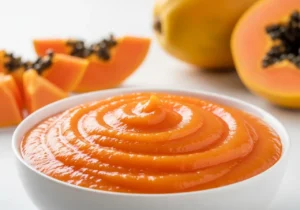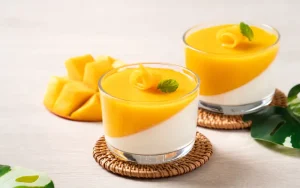
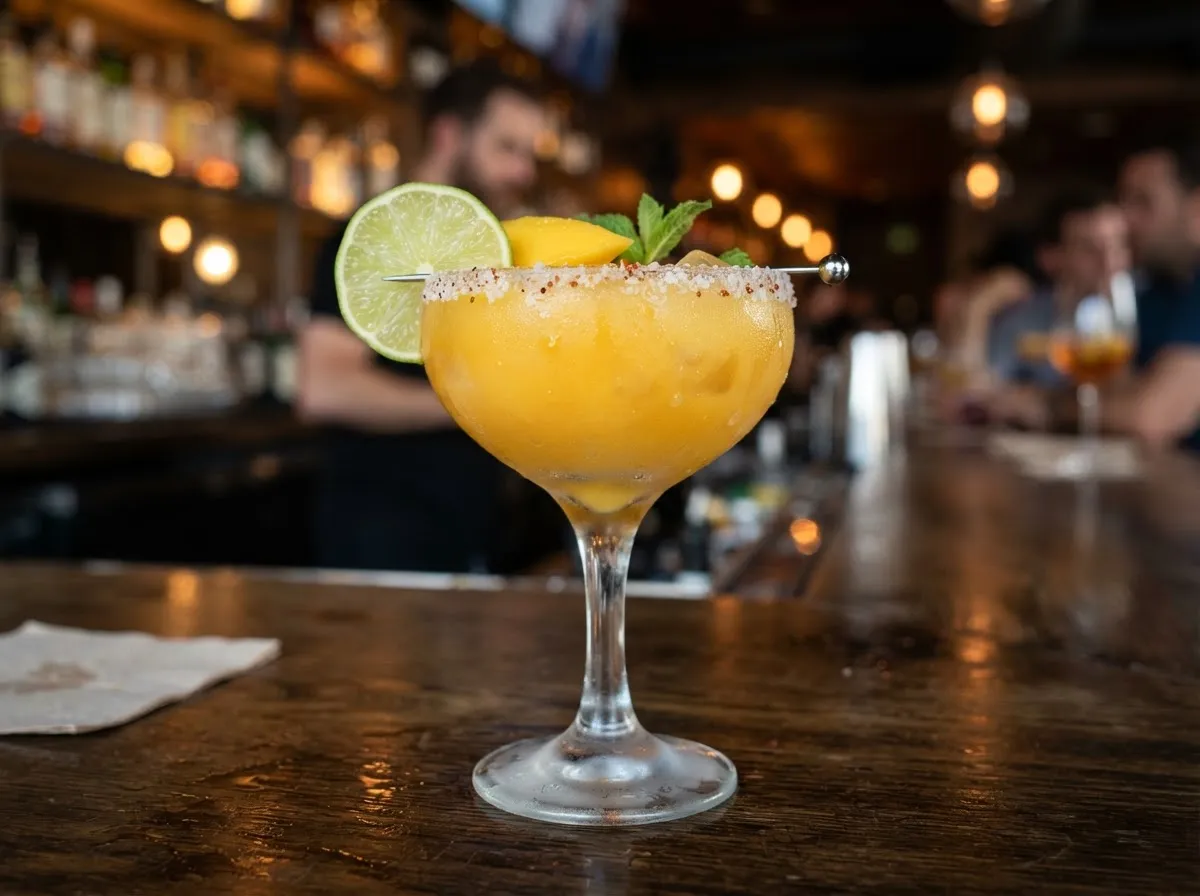
The mango puree for margaritas provides a fruit base that adds flavor, body, and color without processing fresh mango. Bars, beverage plants, and foodservice operations use it to deliver consistent results throughout every service shift.
Next, you will see why bars and manufacturers prefer it, along with the advantages it offers over fresh fruit. You will also see which factors to review carefully before choosing a reliable supplier for your beverage program.
What is mango puree for margaritas?
It comes from ripe mango pulp, which processors refine until they achieve a smooth, uniform texture. Unlike a cocktail mix, this ingredient contains no alcohol or added flavorings whatsoever, keeping formulation control with your team. In fact, mango puree for margaritas provides only real fruit as its defining ingredient, without competing cocktail additives. Afterward, the bartender or formulator determines the final sweetness and acidity for each recipe according to the desired profile.
Within industry, professionals also call this product simple puree when discussing straightforward fruit formulations. In other words, it retains the fruit’s natural soluble solids, without added water or concentration.
How is mango puree made?
Overall, the process protects the mango flavor while also helping manufacturers maintain consistent product safety throughout processing. At an aseptic puree plant, the typical processing sequence follows these six steps in order:
- Receive and select mangoes at their optimal stage of ripeness.
- Wash and sanitize the fruit thoroughly before further processing.
- Pulp the mangoes to separate the peel and seed.
- Refine the pulp to achieve a fine, uniform texture.
- Pasteurize with controlled temperature and holding time.
- Fill aseptically, label each package, and place finished product into storage.
Mango puree vs. juice vs. nectar: how do they differ?
Although all three products come from the same fruit, their composition differs considerably across common beverage applications. Therefore, keep these distinctions clear before formulating any beverage or cocktail recipe for commercial service:
- Puree retains fruit pulp, so it provides body and opacity.
- Juice contains the liquid fraction, with fewer insoluble solids and a lighter texture.
- Nectar is a ready-to-drink beverage made with puree or juice, water, and often sugar.
In a margarita, the difference becomes clear: nectar dilutes the drink, while puree gives it greater density.
Why use mango puree for margaritas in your operation?
Fresh fruit remains unpredictable across batches, seasons, suppliers, and daily purchasing conditions, which complicates consistent beverage formulation. One batch arrives very sweet, the next tastes more acidic, and another yields less pulp. Moreover, the color can shift from pale yellow to deep orange across different fruit batches. By contrast, mango puree for margaritas lets you standardize the result from the first glass through the last.
These advantages matter most to bars and manufacturers seeking predictable results across repeated beverage services:
- Consistent flavor in every service, because processors handle ripe fruit and produce a predictable profile.
- Better texture and body, since refined pulp gives the drink a rounder mouthfeel.
- Faster preparation, because the team no longer peels, cuts, blends, and strains fruit every shift.
- Year-round availability, so the menu does not depend on the harvest season.
- Less waste and handling, because overripe fruit losses largely disappear.
How can you use mango puree for margaritas without a fixed recipe?
No universal puree-to-drink ratio exists across every margarita recipe or service format, so testing remains essential. The right amount depends on the recipe, °Brix, acidity, and the intended profile of your menu. For example, sweeter puree needs less syrup, while more acidic puree requires a lemon adjustment.
This is how the ingredient performs across the most common margarita and beverage formats used in commercial service:
- In frozen margaritas, it adds body and helps keep crushed ice from separating too quickly.
- In shaken or on-the-rocks margaritas, choose well-refined puree so the drink does not feel heavy.
- In mocktails and alcohol-free versions, mango supports flavor when tequila does not provide structure.
- In batch preparation, it enables stable premixes for high-volume service.
If you want to scale mango puree for margaritas, these steps can help standardize the process:
- Define the target sensory profile: fruitier, more acidic, or sweeter.
- Check °Brix and acidity on the technical sheet for every batch.
- Adjust sweetener and lemon according to those measurements, rather than by eye.
- Document the recipe and validate it through testing before adding it to the menu.
What other beverages use mango puree?
The ingredient that works behind the bar also performs well across several other commercial beverage production lines. In fact, mango puree for drinks ranks among the market’s most versatile tropical bases. Its main applications include the following beverage, dessert, and dairy categories across commercial foodservice and manufacturing:
- Smoothies and frozen beverages, where it provides natural creaminess.
- Juices and nectars, as a fruit base formulated with water and sweeteners.
- Cocktails and menu mocktails, because mango puree for cocktails pairs well with rum, mezcal, or sparkling beverages.
- Craft and fermented beverages, including fruit beers, kombuchas, and seltzers.
- Desserts and dairy products, from yogurt and ice cream to pastry fillings.
What should you evaluate when buying mango puree for margaritas?
This is where consistency can succeed or fail across your beverage program and production operation. Therefore, review these criteria with your quality and R&D teams before approving a supplier.
Variety, origin, and flavor profile
Variety determines much of the aroma, color, and fiber content within the finished mango puree. Mango offers notes of orange, peach, pineapple, and caramel, according to the cited flavor reference. Therefore, request samples and confirm that the profile suits your margarita, not merely the specification sheet.
°Brix, acidity, color, and viscosity
These parameters determine how much sweetener and lemon you will need during beverage formulation and recipe adjustment. A simple mango puree typically ranges from 14 to 24 °Brix. Likewise, verify these important details carefully on the supplier’s technical sheet before approving any purchase or production specification:
- pH and acidity, expressed as citric acid.
- Color, which should remain intense and uniform across batches.
- Consistency measured with Bostwick, which matters for pumping and accurate dosing.
- Control of black spots and foreign particles.
Packaging, shelf life, traceability, and supply
The package format should match your consumption volume and your available storage capacity for efficient inventory management. In industrial markets, drums with aseptic bags and bag-in-box packages remain common for commercial puree distribution. Additionally, each unit should show the lot, production date, expiration date, and required storage conditions for traceability.
In the United States, purees used as beverage ingredients fall under applicable Juice HACCP rules and requirements. You can review their scope in the FDA’s Juice HACCP guidance for additional regulatory context. Finally, ask about annual supply capacity, because a stable menu requires reliable deliveries throughout the year.
Simple mango puree vs. concentrate: which suits your operation?
Simple puree retains the fruit’s natural solids and preserves its original composition without concentration. Concentrate, however, undergoes controlled evaporation that removes part of the fruit’s natural water content. As a result, the concentrate reaches approximately 28 to 30 °Brix, creating stronger formulations within smaller volumes. The following table summarizes the principal differences:
| Criterion | Simple puree | Concentrated puree |
| Water content | Natural from the fruit | Reduced through evaporation |
| Solids concentration | Approx. 14–24 °Brix | Approx. 28–30 °Brix |
| Recommended use | Margaritas, smoothies, nectars, and ready-to-drink beverages | Formulas that reconstitute or seek intense flavor in smaller volumes |
| Handling and storage | Doses directly, but requires more space | Saves space and freight; requires controlled dilution |
| Operational fit | Direct dosing with fruit-like texture | High-volume plants controlling reconstitution and logistics |
For margarita bars and lines, simple mango puree is usually the most practical option. It can be dispensed directly and retains a texture close to that of the actual fruit. Concentrates, on the other hand, are better suited for high-volume facilities that control the reconstitution process and aim to optimize logistics.
Mango puree for margaritas from Dream Foods Caribe
At Dream Foods Caribe, we bring the best flavor from our land to beverage manufacturers, bars, and foodservice operations.
Our mango puree for margaritas serves customers who need repeatable results across every production run:
- Consistent sensory profile, with the aroma and color of ripe mango.
- Year-round availability, supported by planned sourcing.
- Aseptic industrial formats, adapted to different production volumes.
- KOSHER and FSSC 22000 certifications, with compliance with 21 CFR Part 117 and Part 120.
- Export capacity and technical sheets with lot-level traceability.
Discover our mango puree and find the format that best fits your production line and operating requirements.
Mango puree for margaritas lets you serve drinks with consistent flavor and texture in every glass. Moreover, it reduces preparation time, waste, and dependence on seasonal harvest availability throughout the year. The key lies in choosing a supplier that supports every batch with clear technical data.
References
- Arotz Food. (2024). 7 ventajas de usar purés de frutas congelados.
- Blue Pacific Flavors. (2024). Mango flavor: Mango uses, pairings, & recipes.
- Frotz Fruits. (2024a). El uso de purés de fruta congelados en la coctelería moderna.
- Frotz Fruits. (2024b). The use of frozen fruit purees in modern cocktail making.