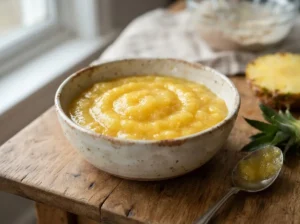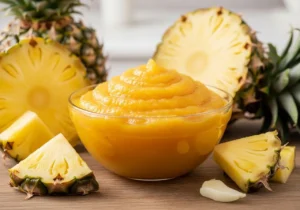
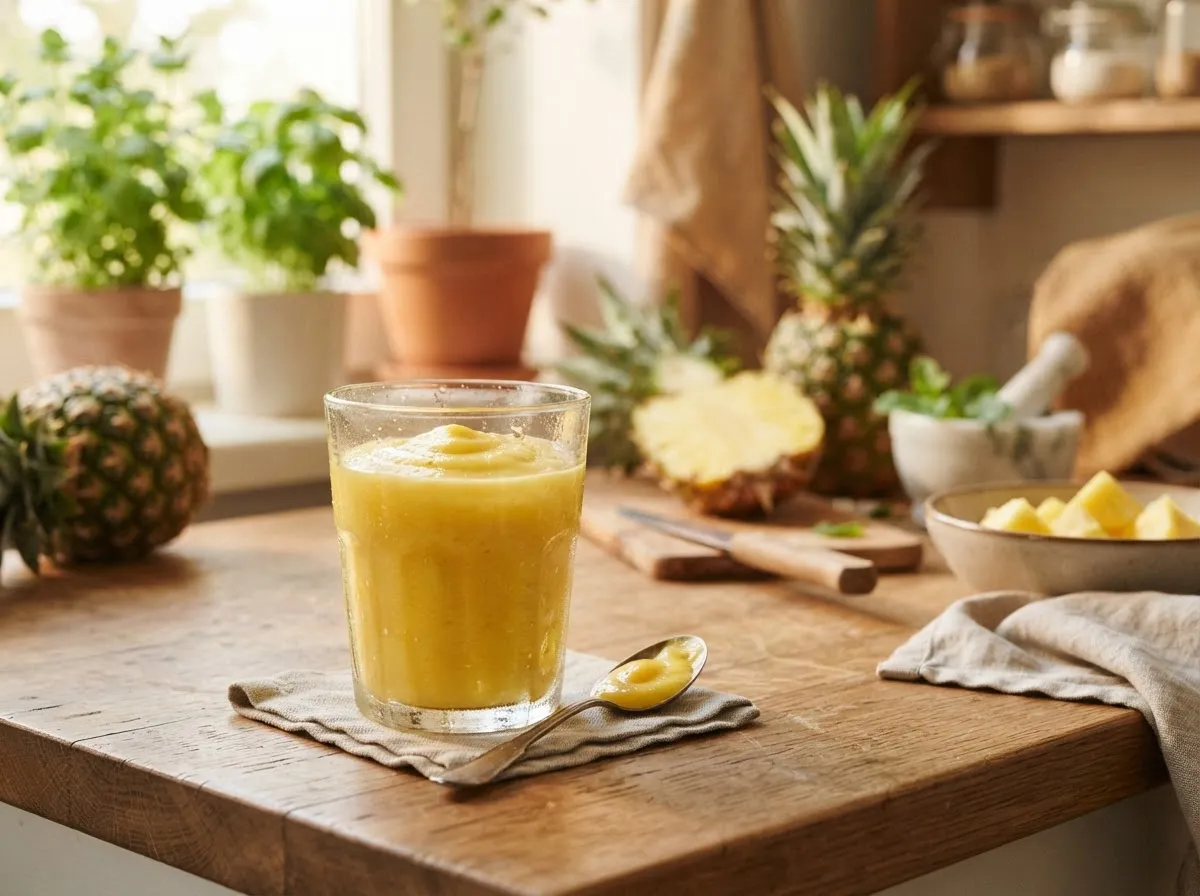
Pineapple puree for drinks decides, before any other ingredient, whether the finished product tastes of real fruit or added flavoring. This natural product arrives undiluted, unconcentrated, unfermented and free of preservatives, coming from the crushed, sieved edible fraction of ripe pineapple. Notably, the pineapple puree single strength grade from Dream Foods enters processing at 9.0 to 14.0 °Brix, with pH between 3.30 and 3.90 and citric acidity from 0.50 % to 0.80 %. Those three ranges govern every formulation decision that follows.
What follows speaks to buyers of raw material who answer for the continuity of a production line. You will find the real difference between puree and juice, the weight of Brix and acidity in sensory balance, and the criteria for choosing between aseptic and frozen formats. Beyond that, this guide covers packaging presentations, how to read a spec sheet without gaps and what to ask a supplier before committing a batch. The language here belongs to the plant floor: specification, traceability and sustained supply.
Pineapple puree for drinks: what it brings to an industrial formulation
Pineapple puree for drinks delivers four attributes at once: defined tropical flavor, real fruit character, deep yellow color and body. Indeed, sieved pulp carries fiber, soluble solids and volatile compounds that no flavor solution reproduces with the same naturalness.
Behind it runs a short, closely watched process: fruit reception and selection, weighing, washing and sanitizing, pulping, refining, pasteurizing and aseptic filling. Moreover, the critical control points sit at the blending stage, where operators verify pH, and at pasteurization, with defined temperature and holding time. The product reaches you with commercial sterility, the characteristic aroma of ripe fruit and a fluid, homogeneous texture without foreign particles. For development teams, that means a stable starting point across batches and fewer surprises when scaling a pilot.
Puree versus juice: the difference that actually reaches the glass
Confusion between the two formats shows up clearly in the finished product. Puree keeps the edible fraction of the fruit and contributes the real body to a blend. Juice, by contrast, works mainly on the liquid phase and leaves a lighter mouthfeel. That explains why the first dominates nectars, smoothies and textured drinks, while the second suits clear references and highly fluid blends.
In that sense, pineapple juice not from concentrate shares fruit origin with puree, though not its rheological behavior. No laboratory should assume a one-to-one substitution between them, because viscosity, solids, opacity and acidity all modify the final profile. The comparison below sums up what a pineapple puree for drinks does differently:
| Characteristic | Pineapple puree | Pineapple juice |
| Texture | Greater body | More fluid |
| Fruit presence | High, with sieved pulp | Lower, liquid phase |
| Opacity | Higher | Generally lower |
| Mouthfeel | Fuller and rounder | Lighter |
| Typical applications | Nectars, smoothies, cocktails | Juices, blends, clear drinks |
| Role in formulation | Contributes body and fruit | Contributes mainly liquid |
Technical specifications worth reviewing before you buy
In practice, the spec sheet for a pineapple puree for drinks must declare soluble solids, pH, acidity, test method and storage conditions. At Dream Foods, soluble solids at 20 °C run from 9.0 to 14.0 °Brix, with pH from 3.30 to 3.90 and citric acidity from 0.50 % to 0.80 %, under method NTC 440.
Sensory descriptors and the microbiological block add to those numbers, and both carry equal weight in an audit. Furthermore, the aroma is intense and typical of ripe fruit, the uniform yellow color may shift slightly through natural oxidation, and the texture stays fluid. The specification demands commercial sterility:
- Soluble solids: 9.0 to 14.0 °Brix, with readings at 20 °C.
- pH: 3.30 to 3.90 at 20 °C.
- Acidity as citric acid: 0.50 % to 0.80 %.
- Heavy metals and pesticides within the permissible limits of the Codex Alimentarius and the European Union (FAO & WHO, 2023).
- No genetically modified organisms or declared allergens; traces of agricultural sulfites below 10 ppm.
- KOSHER and FSSC 22000 certifications, with manufacturing compliant with 21 CFR Part 117 and federal juice rules.
Taken together, that block of data lets you compare offers without relying on perception alone.

Single strength versus concentrate: what changes in the real cost
A single strength represents the fruit at its natural strength, without added water or subsequent evaporation. Therefore, concentrated pineapple cuts volume and freight, yet forces plants to rehydrate and recover the aromas that concentration strips away.
In addition, an unreconstituted pineapple puree for drinks goes straight into the blend, carrying the fruit’s own sensory profile and fewer process variables to control. The real arithmetic sits not in price per kilo, but in cost per liter of finished beverage, adding water, energy, tank time and flavor adjustments. That predictability also supports a short label, which beverage consumers now demand more insistently (Mordor Intelligence, 2025).
Pineapple puree for drinks: aseptic or frozen format in the plant
Above all, format choice answers to logistics before sensory criteria. Aseptic packaging allows ambient storage and frees up cold-room space; frozen product preserves fresh attributes, yet drags along cold chain, energy consumption and thawing times.
Shelf-life ranges turn that preference into a rotation calculation. Aseptic puree from Dream Foods lasts 8 months in a high-barrier polyethylene bag at ambient temperature and 18 months in a bag-in-box below 24 °C. Frozen below -18 °C, it reaches 24 months; refrigerated, it holds for 12. Meanwhile, the presentations span from a laboratory sample to industrial volume:
- High-barrier polyethylene bags of 100, 150, 200 and 1,000 grams.
- Preformed bag with single-use filling valve in 2, 5, 20 and 220 kilograms.
- First-use cardboard boxes or metal drums with a double inner bag.
Consequently, one pineapple puree for drinks serves both a pilot trial and a run of several thousand liters.
How to choose pineapple puree for drinks and what to ask your supplier
Buying a pineapple puree for drinks well starts with demanding documentation and ends with testing a sample. If the sheet omits Brix, pH, acidity, test method and microbiological specification, comparing offers loses all meaning. Likewise, you should verify the health permit, the batch traceability scheme and the certifications currently in force.
Consistency between shipments weighs as much as the numbers, because a shifting color or aroma forces reformulation every season. A defined origin helps. Dream Foods sources its fruit from farms in Santander, Valle del Cauca, Risaralda, Cauca and Quindío, regions that appear in the tropical fruit production statistics FAO publishes. In this way, a United States manufacturer that sources from Colombia gains logistical proximity and continuous harvest.
Questions that bring order to a technical negotiation
Naturally, a purchasing meeting yields more when the questions stay specific and the supplier answers them in writing. These separate the direct producer from the middleman and often decide the award between comparable offers.
Ideally, each answer should match the spec sheet and the certificate of analysis for the batch. Whatever a document omits does not exist for an auditor, so send them together and request a single file back:
- What is the range for Brix, pH and acidity, and which method measures them?
- Is the product single strength or concentrated?
- Does it include added sugar, preservatives or additives?
- Do you offer it in aseptic format, frozen or both?
- Which packaging presentations exist, and what shelf life applies to each one?
- What food safety certifications do you hold, and under which regulations do you manufacture?
- Can you deliver samples, certificates of analysis and sustained bulk volume?
With those answers in hand, the plant sample ultimately becomes the last filter before signing.
Dream Foods: Colombian fruit ready for your next formulation
Dream Foods produces in the La Cayetana free trade zone in Barranquilla and selects the incoming fruit batch by batch. Our pineapple puree for drinks arrives undiluted, unconcentrated, and free of preservatives, with commercial sterility and KOSHER and FSSC 22000 certifications. Accordingly, if you want to broaden your tropical portfolio, request the full spec sheet for our single strength pineapple puree and ask for a sample for your next formulation trial.
References
- United States Food and Drug Administration. (2022). Food Safety Modernization Act (FSMA).
- United States Food and Drug Administration. (2024). Juice HACCP.
- Mordor Intelligence. (2025). Fruit puree market size & share analysis: growth trends and forecasts.
- Food and Agriculture Organization of the United Nations. (2024). FAOSTAT: crops and livestock products.
- Food and Agriculture Organization of the United Nations & World Health Organization. (2023). Codex Alimentarius: international food standards.