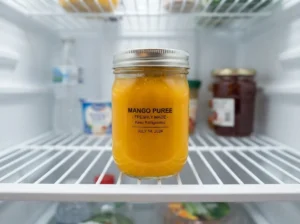
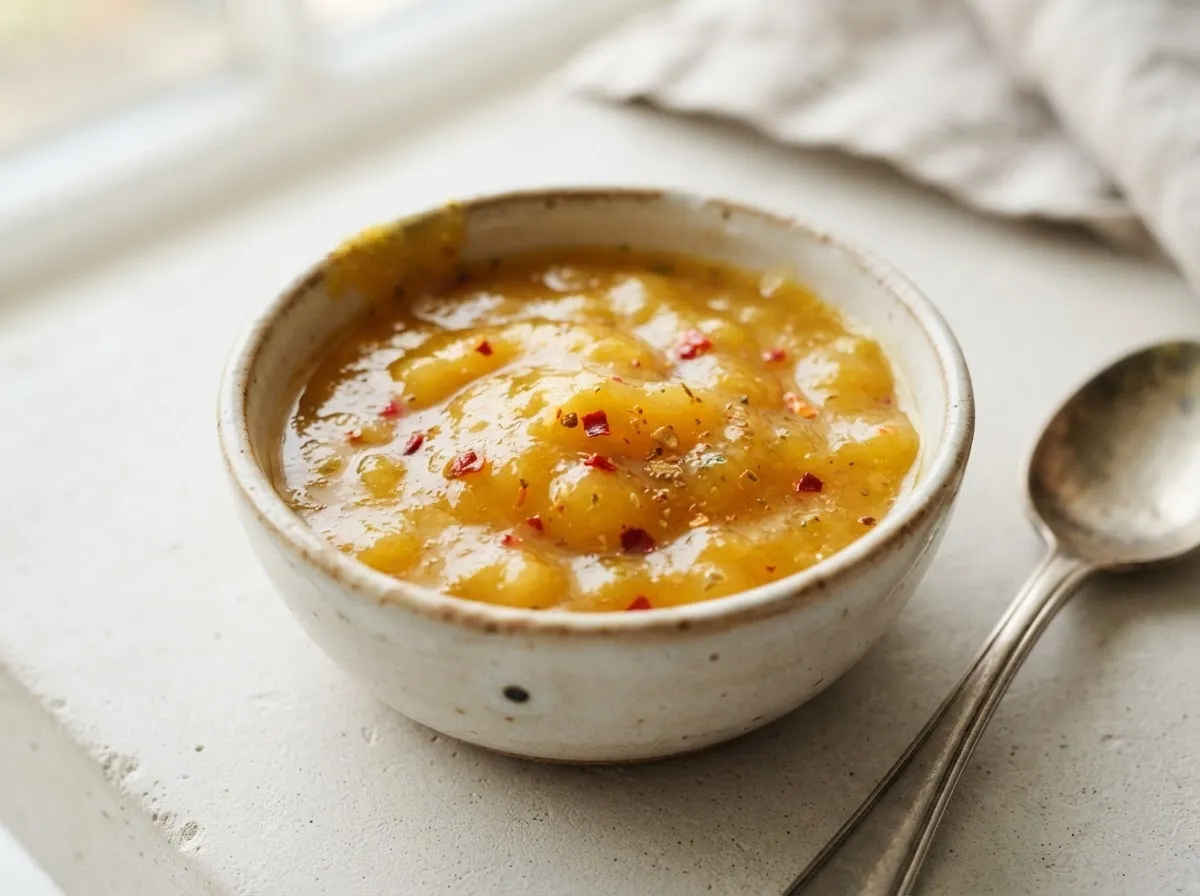

A pineapple puree sauce brings together the sweetness, acidity and body of the fruit in a single recipe. Moreover, development teams consider it for pairing with chili, smoke and spices in their new lines of sauces. This overview explains what the puree adds, how to refine the recipe and what to check before scaling up. Thus, you will reach the sampling stage with clear criteria and with fewer unnecessary trials in the laboratory.
What the puree adds to a pineapple puree sauce
The puree is the fruit, broken down and sieved, and with it come tropical flavor, natural sweetness, acidity, color and body. On that base, the formulator adds chili, spices, vinegar or starch until reaching the character they want. The fruit is not a garnish for the recipe, but the ingredient that shares the spotlight with all the others. Also, the same base works for sweet, savory or spicy sauces, depending on what is added to it.
Sweet-hot, smoky or sweet-and-sour: paths for pineapple
The pineapple puree sauce opens several paths, and each one uses the fruit in a different way:
- Sweet-hot: the sweetness of pineapple softens the chili and leaves a tropical finish.
- Smoky or BBQ: the natural sugar in pineapple caramelizes on the griddle or in the oven.
- Sweet-and-sour: the natural acidity adds freshness to Asian-inspired recipes.
- For dipping and glazing: a fluid puree blends easily into lighter sauces.
Since each path calls for different adjustments, it is best to start from an ingredient that does not change between trials. At Dream Foods Caribe we produce pineapple puree in Colombia. Our single strength pineapple puree can be the starting point for your trials.
Is a pineapple puree sauce for marinating or just for finishing?
It works for both, but the bromelain in pineapple tenderizes meat, and contact time makes all the difference. In a pork trial, the marinade with pineapple juice showed 551.28 units/g of protease activity and received the lowest tenderness scores (Park & Park, 2026). However, the authors suggest applying pineapple with control, either with lower doses or with shorter marinades.
Does a pineapple puree sauce have body without thickeners?
The puree adds pulp and some consistency, but the final body depends on the solids and the thickener chosen. In an oyster sauce, 4% acetylated distarch phosphate kept the texture during storage, and the instability index did not change significantly over 90 days (Li et al., 2024).
Since it was a single trial, treat it as a clue and confirm the dose with your own equipment. That is why you should measure viscosity with the pumping and filling equipment of your plant.
Juice or puree to flavor the sauce?
In a pineapple puree sauce, juice does not replace puree one to one, because it has less pulp. Also, the solids, the viscosity and the acidity change, so it is advisable to test the formulation before modifying the recipe. A reference sample helps compare both ingredients under the same criterion.
Fine-tuning a pineapple puree sauce: the flavor levers
Balance comes from moving a few variables at a time, and each one answers a different decision:

- Sweetness: start from what the puree already brings before adding any sugar.
- Acidity: pineapple brings its own, so add vinegar or citrus only after tasting.
- Heat: dose the chili in stages, because the sweetness of the fruit can mask it at first.
- Salt and spices: adjust them at the end, once the profile of the fruit is already defined.
- Body: choose the starch or gum according to the filling equipment you will use at the plant.
Finally, the proportion of puree changes with each recipe, and there is no single figure for every product.
From bench to plant: repeat the recipe before scaling up
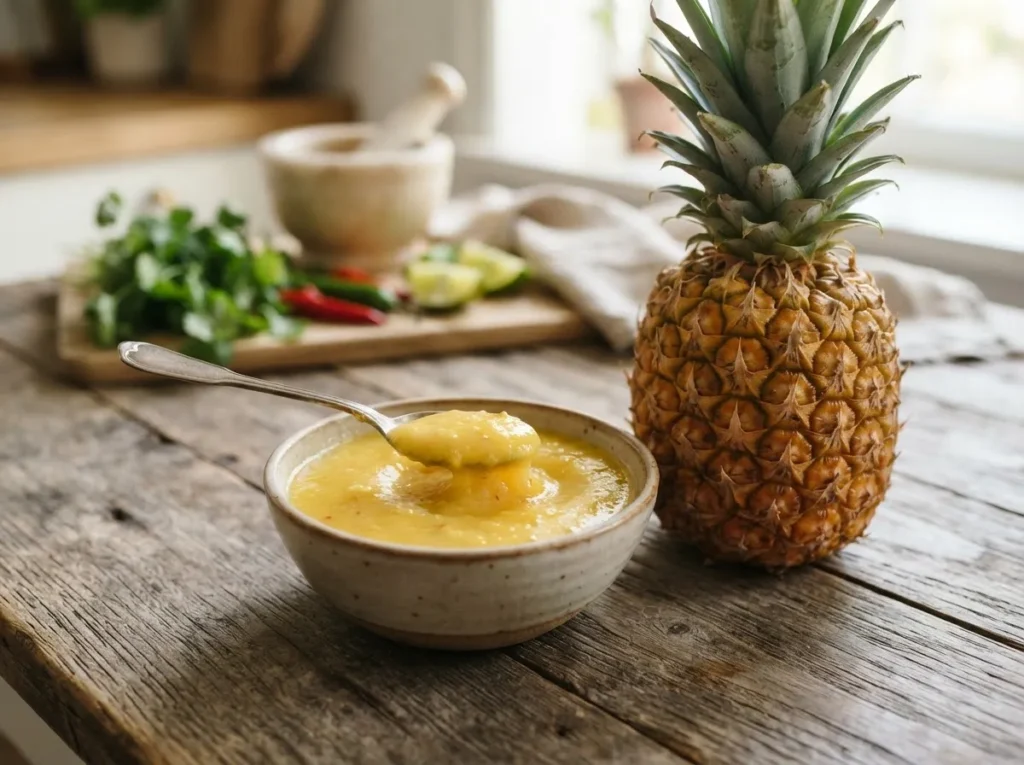
A pineapple puree sauce that works in the laboratory must be repeated in a pilot batch. That is why you should test the recipe with more than one batch of puree and measure the same things in every trial. Compare color, texture and flavor against a reference sample. Then, an internal tasting panel can validate the result.If the recipe contains vinegar or another acid and is packed sealed, it may be classified as an acidified food, with its own process requirements.
The puree tests that matter for your pineapple puree sauce
Our puree ranges from 9.0 to 14.0 °Brix, with a pH of 3.30 to 3.90 and an acidity of 0.30 to 0.80%. Each figure answers a different question about the recipe:
- °Brix: how much fruit and how much natural sugar goes into the kettle.
- pH and acidity: how much additional acid the formula will need.
- Microbiology: commercial sterility, absence of Listeria monocytogenes and Salmonella, and E. coli below 10 CFU/g.
- Sensory: intense aroma of ripe pineapple, uniform yellow color and fluid texture.
Colombian origin for your pineapple puree sauce: what to check
Dream Foods Caribe produces from the La Cayena Free Trade Zone in Colombia, with traceability and international distribution. Its puree is packed as aseptic pineapple puree and travels without a cold chain. In addition, the plant works under GMP and holds Kosher and FSSC 22000 certifications. The process also complies with 21 CFR Part 117, FSMA and Juice HACCP. To sell in the United States, review the FDA’s preventive controls for human food, which also apply to registered foreign facilities.
What does single strength mean for a pineapple puree sauce?
It means that the puree is not diluted or concentrated and keeps the natural proportion of fruit and sugar. On that basis, the recipe starts from known values; with a concentrate, by contrast, you must reconstitute and recalculate before every trial. Thus, two offers from different suppliers are compared on the same fruit basis.
Does this puree contain preservatives?
No: it is natural, undiluted, unconcentrated, unfermented and free of preservatives, and it is obtained from ripe pineapple. Between the fruit and the packaging there are selection, washing, refining, pasteurization and aseptic filling, and the product is non-GMO and not considered an allergen. The label of your sauce will also depend on what you add.
How it reaches your warehouse: bag, drum or small sample
The packaging should fit the rhythm of your pineapple puree sauce, from trials to continuous production:
- Samples and trials: high-barrier polyethylene bags, from 100 g to 1000 g.
- Continuous production: aseptic bags from 2 kg to 220 kg.
- Larger volumes: metal drums with a double polyethylene lining.
That said, shelf life ranges from 8 to 24 months and changes with storage conditions.
The same fruit in other lines: from meat to cake
Beyond the pineapple puree sauce, the puree finds a place in nectars and beverages, jams and jellies, ice creams and dairy products. For example, in pastry it is worth testing pineapple puree for cake in fillings and batters. Therefore, a single puree reference can supply several lines and simplify purchasing.
The sauce market and the role of pineapple puree sauce
Sauces account for about 10% of food and beverage launches and grow 6% annually (compounded). Moreover, the blend of sweet and spicy, called swicy, sets the pace (Helm, 2025). These examples show that crossover:
- Hot honey: leads the swicy trend with its mix of sweetness and heat.
- Aji amarillo: Peruvian chili with fruity and tropical notes, named McCormick’s 2025 flavor of the year.
- Chamoy and ponzu: pickled fruit and citrus as the base of other sauces.
Pineapple shares that tropical profile, and the puree takes it to the plant with the fruit already refined.
Let’s talk about your next pineapple puree sauce
Your plant has the process, the equipment and the market. What it needs is an ingredient that behaves the same in every batch. At Dream Foods Caribe we turn Colombian fruit into a puree with defined values, ready to integrate into your line. With a stable raw material, your team can spend less time correcting each batch and more time differentiating your brand.
Our sales team studies your project, quotes your wholesale purchase and sends samples for the first trials. Visit our website and find out how our ingredients can raise the production of your company.
Referencias
- Helm, J. (2025, June 1). Trend watch: A surge in global sauces. Today’s Dietitian.
- Li, X., Zou, F., Kang, X., Gao, W., Cui, B., & Sui, J. (2024). Effects of acetylated distarch phosphate on the physicochemical characteristics and stability of the oyster sauce system. Frontiers in Nutrition, 11.
- Park, I., & Park, O. K. (2026). Impact of fruit-based sugar substitutes on meat tenderization and quality characteristics of pork bulgogi. Foods, 15(13), Article 2319.