
The guava puree market is the industrial trade of processed pulp for beverages, dairy products, ice cream, and desserts. According to several firms, it is now worth between USD 450 and 550 million and grows nearly 5% a year. That expansion stems, above all, from demand for tropical flavors, clean labels, and ready-to-drink beverages. For manufacturers, this opens room to innovate, yet it demands suppliers with stable quality, technical documentation, and year-round supply.
What is the guava puree market
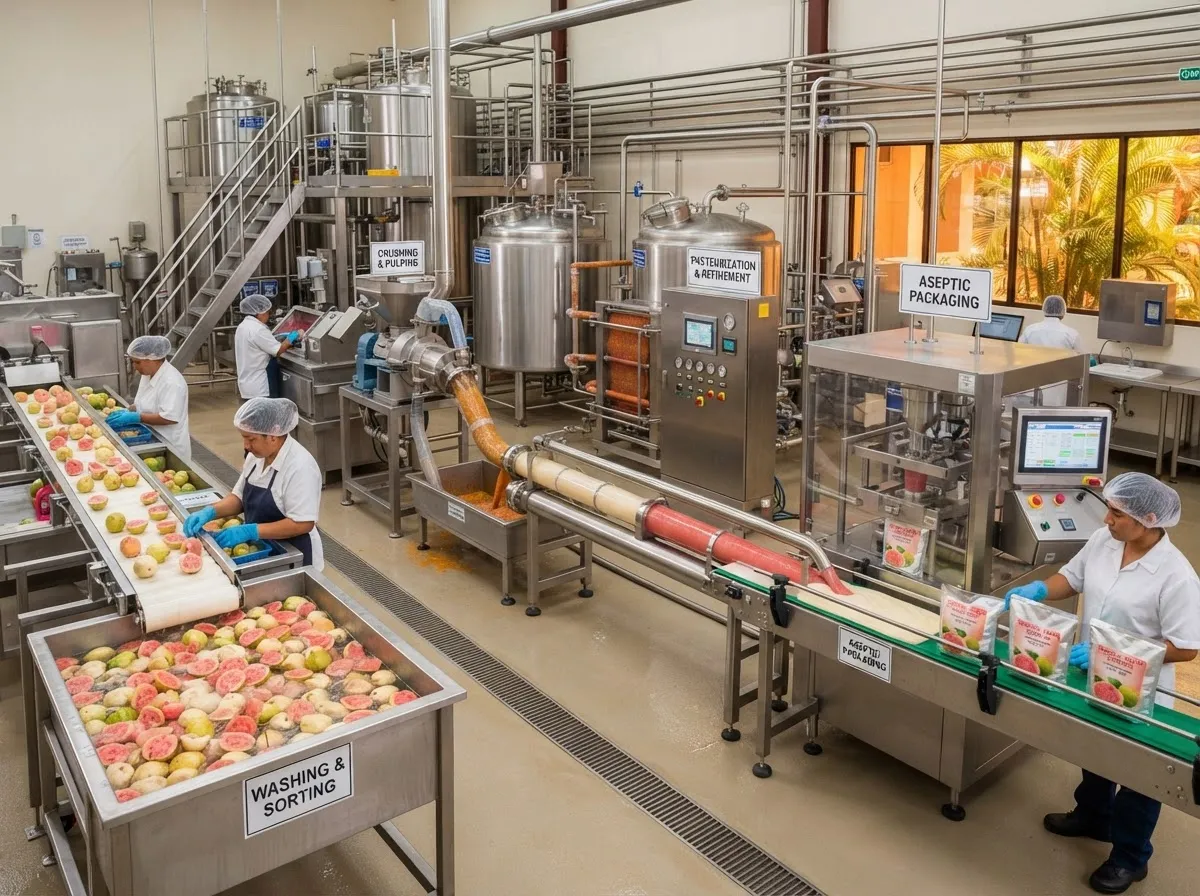
In simple terms, the guava puree market is the business-to-business trade of guava that has already undergone processing. That is, the fruit arrives washed, pulped, refined, and pasteurized, ready to enter the production line right away. Fresh guava, by contrast, is perishable, varies in ripeness, and requires its own processing steps inside the plant.
This category brings together several products that differ in form and use:
- Single-strength puree, with no concentration or dilution of any kind.
- Concentrated puree, which carries more soluble solids and takes up less volume during transport.
- Aseptic and frozen purees, which differ from each other mainly in their preservation method.
On the demand side, the main buyers are manufacturers of beverages, dairy products, ice cream, bakery goods, and baby food. Ingredient distributors that serve several industries at once also round out this core group of buyers.
What drives the growth of the guava puree market
Behind these figures lie concrete shifts in what consumers and brands demand, led by these visible drivers:
- Tropical flavors: in the U.S., guava grew 40% on restaurant menus over four years (Flavor & The Menu, 2025).
- Clean labels: brands leverage the fruit’s natural color and sweetness to replace additives in their formulas.
- Ready-to-drink beverages: these formats need ingredients that stay stable and remain easy to dose.
- Aseptic processing: it lets companies store the puree at room temperature and cut cold chain costs.
- Functional beverages: guava’s fiber and fruity profile fit naturally into wellness-oriented product concepts.
In fact, U.S. consumers already know the fruit well, as 76% are familiar with it (Nation’s Restaurant News y Datassential, 2025). Beyond familiarity, nearly half of them have already tasted it, with the trial rate reaching 48%. That is why a guava launch carries less risk than betting on an unfamiliar fruit.
What are the main applications of guava puree
For research and development teams, the answer to what to do with guava puree covers a wide range of options. Even so, a few categories concentrate a large share of the volume that moves through this market.
Beverages: The category that leads demand
Currently, beverages represent 53.6% of global use, from juices and nectars to smoothies, flavored waters, and functional drinks (Future Market Insights, 2026). Even cocktails and coffee-based drinks now incorporate guava for its color and its sweet-tart flavor. As a result, formulators seek a puree that keeps the same profile from lot to lot.
Dairy, ice cream, and other uses
Beyond beverages, guava puree also adapts easily to several other production lines across the food industry:
- Dairy: set yogurts, drinkable yogurts, and refrigerated desserts.
- Ice cream and frozen desserts: the puree’s texture adds body and delivers an intense fruit flavor.
- Bakery and confectionery: fillings, glazes, jams, and jellies.
- Baby food: purees and compotes, where buyers value ingredients with no added sugar.
- Sauces and foodservice: meat glazes, vinaigrettes, and preparations for industrial kitchens.
What types of guava puree do manufacturers request?
Not every puree meets the same need, so it pays to know the differences before requesting a quote.
Pink guava and white guava
Today, pink guava puree leads with a 47.8% share (Future Market Insights, 2026), and its intense color makes it ideal for premium or tropical beverages. Conversely, white guava offers a lighter tone and a milder flavor in the final product. Consequently, manufacturers often choose it when its color must not interfere with the other ingredients in a formula.
Concentrated or single-strength puree
By format, concentrate leads with 42.3% of the market (Future Market Insights, 2026), and its key advantage is a lower transport volume. Nevertheless, plants must then reconstitute it on site and keep that dilution under tight control. Single-strength puree, meanwhile, arrives ready to use and preserves the original flavor of the fruit.
At Dream Foods, we produce a 100% natural single-strength guava puree, with no concentration, dilution, or preservatives.
How the guava puree market performs in the United States
The United States is one of the key destinations in the guava puree market today. Its market reached USD 124.2 million in 2024 (Global Industry Analysts, n.d.) and should grow 5.0% annually from 2026 (Future Market Insights, 2026). Because local production remains limited, the industry depends on tropical origins in Latin America and Asia.
For this reason, purchasing teams evaluate far more than price, and they will usually request:
- Complete technical sheets and certificates of analysis per lot.
- Compliance with FSMA, 21 CFR 117, and the juice HACCP plan that the FDA requires.
- Full traceability from the farm all the way to final dispatch.
- Certifications such as FSSC 22000 and Kosher.
- Packaging compatible with their lines, along with continuity of supply.
What role does Colombia play as an origin?
Colombia is gaining prominence in the guava puree market thanks to its extensive cultivation area. This wide footprint makes it easier to secure a steady supply of fruit throughout the entire year. On top of that, the country benefits from its location, with Caribbean ports close to the U.S. East Coast.
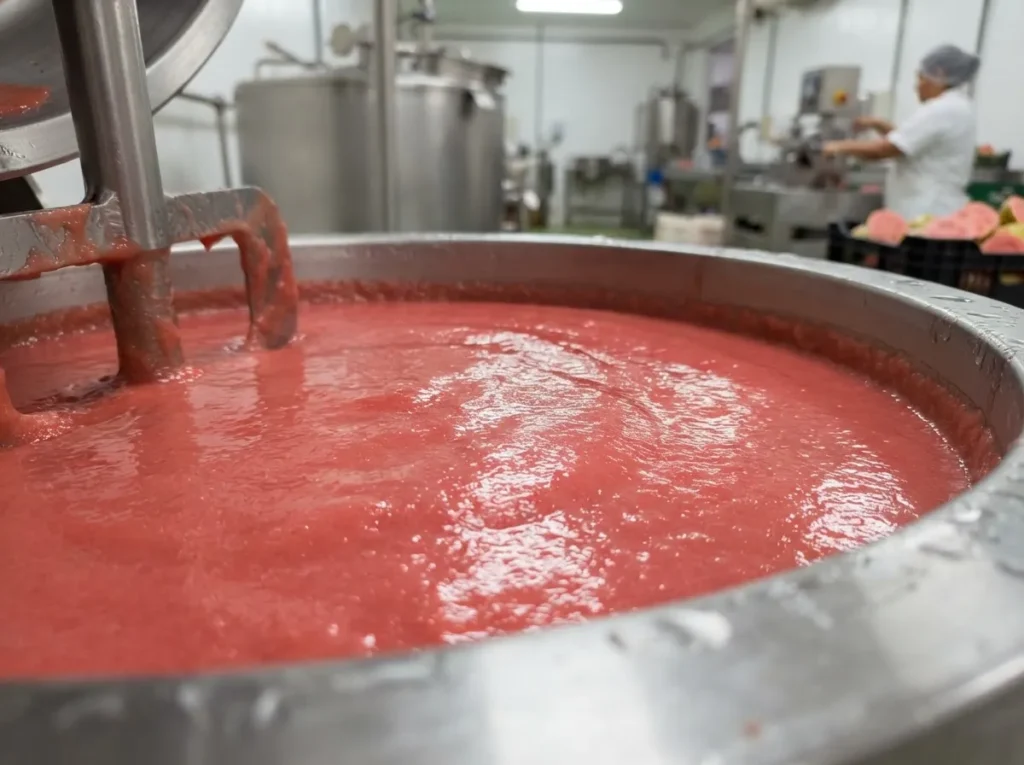
In our case, we process the fruit at Zona Franca La Cayena, located in Barranquilla, Colombia. This way, we combine fruit from several regions with agile export logistics, giving buyers flexibility without sacrificing international safety standards.
What factors influence the price of guava puree?
In the guava puree market, the B2B price changes with every order, so a fixed list price makes no sense. Generally speaking, each final quote depends on a combination of the following key variables:
- Fruit variety and raw material availability during the harvest season.
- Degrees Brix and the concentration level of the puree.
- Preservation format: aseptic or frozen.
- Packaging type and order volume.
- Origin, Incoterm, and logistics costs all the way to the plant.
- Certifications and the client’s quality requirements.
What specifications should you review before buying guava puree?
Before approving a supplier, it is worth reviewing its technical data sheet point by point with your team. For reference, these are the main technical specifications that define our own single-strength guava puree:
- Brix: 8.0 to 11.0 °Brix, a typical range for unconcentrated fruit.
- pH and acidity: pH from 3.50 to 4.20 and acidity from 0.50% to 0.80%, as citric acid.
- Sensory profile: uniform color, fluid texture, and ripe fruit flavor.
- Microbiology: commercial sterility and absence of Salmonella and Listeria monocytogenes.
- Ingredients: 100% guava, with no added sugar or preservatives.
- GMO and allergen status: non-GMO product, free of allergens.
- Certifications: FSSC 22000 and Kosher, with full FSMA and HACCP compliance.
- Packaging and shelf life: 2 to 220 kg aseptic bags and up to 24 months, depending on storage.
Aseptic or frozen guava puree: Which one suits you best
Both formats have clear advantages; on the one hand, aseptic puree keeps at room temperature and eases long-route logistics. Frozen puree, on the other hand, offers the longest shelf life, although it requires a cold chain. Ultimately, the right choice will depend on your storage capacity, consumption volume, and production timelines.
Where the guava puree market is heading
Projections from several research firms point to sustained growth over the next decade for this category. Beverages will remain in the lead, while pink guava, clean labels, and aseptic formats continue to gain ground. Likewise, traceability will no longer be an added value but a basic requirement for suppliers.
In short, the guava puree market rewards those who combine flavor, consistency, and solid technical support. If you are looking for a reliable supplier for your formulations, we at Dream Foods are ready to support you. After all, our purpose is to bring the best flavor of Colombian soil straight to your plant.
References
- Flavor & The Menu. (2025, February 17). Guava gains ground.
- Future Market Insights. (2026, April 8). Global guava puree market outlook 2026-2036: Clean-label beverage innovation and tropical sourcing expansion drive 5.7% CAGR growth [Comunicado de prensa]. Bolsamanía.
- Global Industry Analysts. (n.d.). Guava puree [Resumen de informe de mercado]. GII Research.
- Global Market Insights. (n.d.). Tamaño del mercado de puré de guayaba: informe de análisis de la industria, perspectivas regionales, potencial de crecimiento, cuota de mercado competitiva y pronóstico, 2025-2034.
- Nation’s Restaurant News y Datassential. (2025, January 27). Guava, a photogenic tropical fruit. Nation’s Restaurant News.