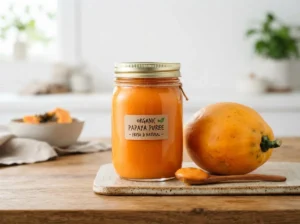


Mango puree for cheesecake adds flavor, color, aroma, and a silky texture to fillings, no-bake versions, and toppings. On the plant floor, furthermore, it replaces the peeling and pulping of fresh fruit with a ready-to-dose ingredient. A standardized single-strength mango puree, like the one from Dream Foods, keeps flavor and texture consistent across batches. The exact dose you need depends on its consistency, sweetness, acidity, and overall level of concentration.
For procurement and R&D teams, the real question is not whether it works, but how to specify it. In this guide, you will find its uses, the factors that set the dose, and the causes of watery cheesecake. Additionally, you will see how aseptic and frozen formats differ, how puree and concentrate compare, and what to ask suppliers before scaling.
Mango puree for cheesecake: flavor, color, and texture
Within a formula, mango puree for cheesecake does much more than act as a simple flavoring agent. It consists of fruit pulp with its own sugars, acids, and water, so it shapes the filling’s taste and body.
For that reason, development teams evaluate it as a technical component rather than a mere decorative touch. When the puree has a smooth body and an intense color, the effect shows from the very first slice. Its most visible contributions to the finished product, from aroma to appearance, are the following:
- Flavor: sweet and tart notes typical of ripe fruit, with no off-flavors.
- Color: an intense yellow that stays uniform throughout the filling and the topping.
- Aroma: a recognizable tropical profile from the moment you open the package.
- Moisture and texture: water and fine fiber that soften the matrix and that you must balance against the rest of the formula.
Ultimately, that balance between sensory contribution and free water determines whether puree or whole fruit makes more sense.
Can puree replace fresh mango in cheesecake?
Yes, and in industrial production it often proves to be the most practical option available. Fresh mango varies in ripeness, fiber, and sweetness depending on the time of year it reaches the plant. Growers, for example, harvest the fruit from April to July and again from December to January. In addition, FAO agricultural statistics let buyers track that supply by country and by year.
The puree that Dream Foods processes arrives pulped, refined, and pasteurized, with parameters that its own laboratory measures. As a result, it cuts hours of prep work and gives the R&D team a predictable base for formulating:
| Factor | Fresh mango | Mango puree |
| Preparation | High | Low |
| Consistency | Variable | Standardizable |
| Texture | May contain fiber | Homogeneous |
| Availability | Seasonal | More controllable |
| Scalability | Limited | High |
| Formulation control | Variable | More predictable |
With the raw material settled, the next step is deciding where in the product the puree goes.
From filling to topping: ways to work with the puree
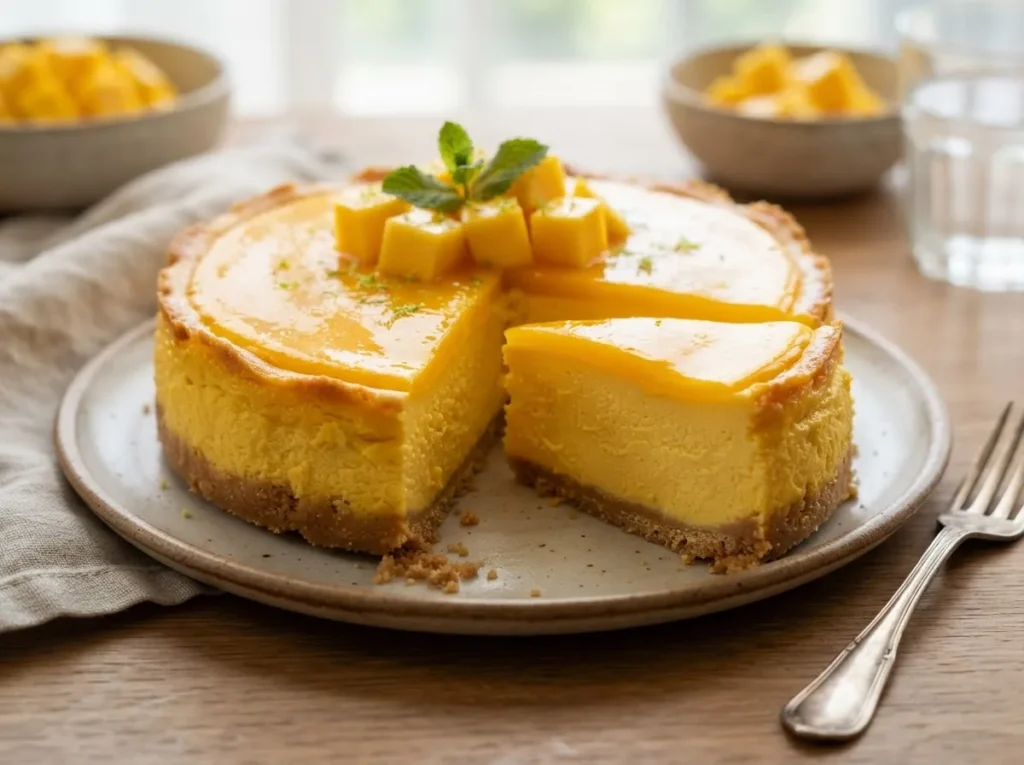
In the filling, mango puree for cheesecake blends with the cream cheese until it forms a smooth, homogeneous mass. For the no-bake version, meanwhile, structure relies on cold temperatures and a gelling agent such as gelatin or pectin.

Baked cheesecake also accepts puree, although its behavior depends on the eggs, the baking time, and the formula’s total water. As a topping, on the other hand, it offers more freedom: you can reduce the puree into a coulis, bind it into a glaze, set it in a gelatin layer, or trace it in ribbons (swirl) across the surface.
How much mango puree for cheesecake should you use?
There is no universal ratio of mango puree for cheesecake that works across every product and every plant. Published recipes vary widely because each one starts from a different base, with its own ingredients and ratios. On an industrial line, therefore, teams define that figure through formulation trials, not by copying a home recipe.
Concentration matters just as much as the recipe itself when you set a target dose for production. Dream Foods’ single-strength puree registers between 14.0 and 24.0 °Brix, while its concentrated version ranges from 27.5 to 28.5 °Brix. With more solids per gram, the concentrate delivers flavor while bringing less water into the filling. Before you lock in the dose, it is worth reviewing these variables one by one:
- The type of cheesecake, baked or no-bake, and the flavor intensity you want to achieve.
- Puree °Brix, acidity, moisture, and viscosity.
- The amount of cream cheese and the use of gelatin, pectin, or other structuring agents.
- Puree placement: inside the filling or as a topping.
Changing just one of these variables alters how the product slices, and that is where the texture challenge begins.
Why some mango cheesecakes turn watery
Cream cheese already carries plenty of water: the US standard requires at least 33% milkfat and allows up to 55% moisture. If you add a fluid ingredient without offsetting that load, the matrix then loses firmness and releases liquid once you slice it.
However, puree on its own does not ruin a filling, because the outcome depends on the complete formula. A mango puree for cheesecake with a controlled viscosity reduces that risk in the finished filling. Dream Foods’ spec sheet for its single-strength puree sets Bostwick consistency between 7 and 15 cm in 30 seconds. To maintain a stable slice in every batch you produce, the following practices prove especially helpful:
- Calculate the formula’s total water, adding the puree’s contribution to that of the cream cheese.
- Choose a puree with °Brix and viscosity suited to the application, or a concentrate if there is excess water.
- Adjust the dose of gelatin, pectin, or starch according to the proportion of fruit.
- Allow the full refrigeration time before slicing and packaging.
Many of these decisions, in fact, happen when you choose the puree, well before mixing begins.
How to choose the puree: specs, format, and concentration
Measurable criteria, not adjectives, answer the question of which puree works best for a cheesecake. A complete technical data sheet lets you compare different suppliers side by side using the same numbers. The pH, for instance, influences how pectin performs, and acidity shows how much sugar you will need to balance flavor.
When evaluating a mango puree for cheesecake, the purchasing department should request, at a minimum, the following data:
- °Brix, pH, and acidity in terms of citric acid.
- Consistency or viscosity, plus the method the lab uses to measure it.
- Color, aroma, and flavor results from sensory analysis.
- A count of black and brown specks, along with maximum particle size.
- Ingredient declaration, added sugar, preservatives, and allergens.
- Microbiological results and a commercial sterility test.
With that information on the table, the next decision involves the delivery format that best suits your plant.
Aseptic or frozen: the answer lies in your operation
Aseptic processing pasteurizes the puree and fills it into sterile bags that allow storage at room temperature. At Dream Foods, this format lasts 18 months when you keep it below 32 °C (89.6 °F). As for packaging, the company ships it in 220 or 230 kg drums and in 20 kg bag-in-box units.
Frozen puree, for its part, demands an unbroken cold chain and freezer space, which works if the plant already has that infrastructure. Neither option wins in every case: it all depends on volume, production frequency, logistics, storage, and required shelf life.
Single-strength or concentrate: same fruit, different dose
Single-strength puree retains the fruit’s natural water, whereas concentrate goes through evaporation to raise its soluble solids. Dream Foods’ concentrate shows a Bostwick consistency of 3 to 7 cm and an acidity of 0.5% to 1.15%. That is why formulators dose it in smaller amounts and must adjust the sweetness to compensate.
This choice, in reality, rarely stays within the walls of the pastry and dessert department. The same buyer may supply desserts with single-strength puree and request quotes on mango concentrate for smoothies, where milk or yogurt already adds liquid. For beverages, buyers want mango puree for margaritas fluid and color-stable, so unifying specs with one supplier simplifies purchasing.
Mango puree for cheesecake at scale: from sample to production line
Scaling a mango filling without surprises requires documents and trials that go well beyond the price per kilo. Before approving a supplier of mango puree for cheesecake, request the spec sheet and a certificate of analysis (COA) for each lot. Your team should also review allergen data, certifications, origin, and traceability before signing off on the supplier.
For juices and purees entering the United States, the HACCP plan must achieve at least a 5-log reduction in the pathogens of concern. The Codex Alimentarius, in turn, organizes that same food safety system into seven guiding principles (FAO y OMS, 2023). With that foundation in place, supplier validation usually follows this sequence from first sample to full production:
- Request samples from a commercial lot, not just from the lab.
- Run trials in the actual formula, with the structuring agents you plan to use.
- Validate flavor, color, slicing, and cold stability throughout shelf life.
- Move to pilot production and then to commercial volumes with agreed specifications.
Reviewing packaging and warehouse conditions at this stage prevents rework once order volumes start to grow.
Dream Foods: Colombian mango ready for your next formulation
From the La Cayena free trade zone in Barranquilla, Dream Foods processes Colombian mango through sorting, washing, pulping, refining, pasteurization, and aseptic filling. Its puree is non-GMO and free of preservatives and allergens, and it holds Kosher and FSSC 22000 certifications. Moreover, the same ingredient that stabilizes a cheesecake performs well in mousses, cakes, glazes, ice creams, and yogurts.
If your team is defining specs for next season, the logical next step is reviewing the data sheet for mango puree single strength. After that, running a sample in your own formula will tell you everything else you need to know.
References
- Cream Cheese, 21 C.F.R. § 133.133 (2026).
- FAO y OMS. (2023). Principios generales de higiene de los alimentos (CXC 1-1969). Codex Alimentarius.
- Hazard Analysis and Critical Control Point (HACCP) Systems, 21 C.F.R. pt. 120 (2026).