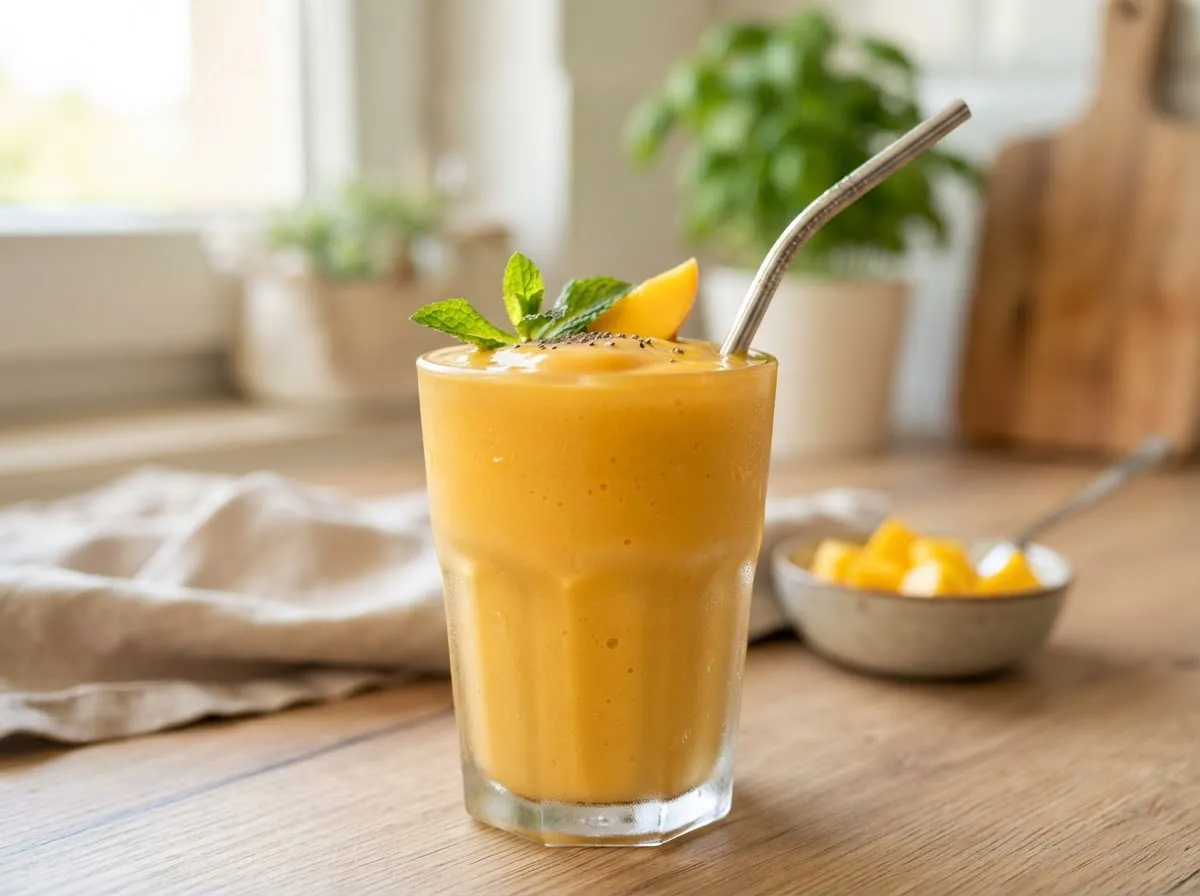

Mango concentrate for smoothies delivers intense flavor, deep color, and sweetness, and lets you control dosage in every batch. Meanwhile, the exact amount depends on degrees Brix, on acidity, and on the rest of your formula.
Before you set a standard, review the technical sheet and validate the recipe at pilot scale. Moreover, every plant works with different equipment, a different cold chain, and clearly different volumes. Therefore, you specify a mango concentrate for smoothies; you never improvise it on the plant floor.
What is mango concentrate for smoothies?
First, understand exactly what arrives inside the drum before you adjust a single line of your formula. The format defines dosage, the sensory profile, and, just as importantly, the logistics behind every shipment.
Knowing this ingredient well prevents costly reprocessing and, in addition, needless arguments with your supplier.
How do producers obtain it, and why does flavor intensify?
Everything starts with ripe fruit, which operators wash, depulp, and then refine on the processing line. Afterward, controlled and careful evaporation removes part of the water still held inside the pulp. The process preserves aroma and color while, at the same time, it reduces total volume. This allows mango concentrate to ship more efficiently and optimizes transportation costs.
Consequently, soluble solids climb, and the flavor gains noticeable intensity in the final beverage blend. Fresh mango holds close to 83% water (USDA, n.d.), so that reduction genuinely matters here. If you prefer a lighter profile, plain mango puree remains an excellent option for your line.
What does the concentrate bring to the final drink?
Indeed, a good concentrate resolves several fronts at once inside the same commercial beverage recipe. Each one shapes how the final consumer perceives your drink at that very first sip. Below you will find the contributions that weigh most once the formula reaches your plant:
- Flavor. It delivers intense tropical notes even at small doses.
- Sweetness. Fruit sugars arrive too, so your added sweetener drops.
- Color. That orange-yellow tone consumers expect stays firmly in place.
- Acidity. Balance improves, and the sensory profile holds over time.
- Body. Mouthfeel grows without any extra thickeners in your formula.
Taken together, these contributions explain why so many beverage plants clearly prefer the concentrated format. However, each benefit depends on a dosage that your team calibrates with genuine care beforehand. Without a prior calculation, the flavor may overwhelm the drink or else fall noticeably short.
How much mango concentrate for smoothies should you use?
No universal figure exists, so treat anyone who promises one with a healthy dose of suspicion. The correct dose emerges from the technical sheet and from the final beverage formula itself. Copying someone else’s recipe rarely works, so close the range with your own pilot trials.

Factors that define the dosage
Several variables move the needle when you adjust a mango concentrate for smoothies in production. None of them act alone inside the mix, so review them together as a whole. Check the following points carefully before you close the inclusion percentage:
- Brix. It shows how many soluble solids each kilo contributes.
- Acidity and pH. Together they define balance and the freshness sensation.
- Liquid base. Water, milk, or yogurt change the outcome completely.
- Companion fruits. Pineapple or passion fruit compete directly with mango.
- Ice. Dilution rises, so intensity drops right at serving time.
- Portion. A 12-ounce drink never follows a 20-ounce formula.
With these variables on the table, your formulation stops being a purely blind trial-and-error exercise. Document every single adjustment on a simple control sheet that your whole team shares. That record makes the next shift’s work considerably easier.
How does it dilute inside the formula?
The logic stays simple: concentrate, liquid base, secondary ingredients, and, finally, ice. Start from the Brix on the sheet and calculate the target Brix for your drink. Then adjust through laboratory trials and log every single result you obtain along the way.
A mango puree for smoothies, for instance, calls for an entirely different dilution ratio. Afterward, document the exact proportion that actually worked inside your own plant. That record turns a mango concentrate for smoothies into a genuinely repeatable production formula.
Mango concentrate for smoothies versus mango puree
Both come from the same fruit, although they behave quite differently inside the plant. Puree keeps the pulp and therefore gives the drink a natural, satisfying body.
Concentrate, by contrast, prioritizes flavor intensity, logistical efficiency, and a lower cost per liter.
When does each format make sense?
Your choice depends above all on the result you want to see inside the glass. Think first about texture and afterward about the yield you get per kilo. These practical signals help you decide without overthinking the matter for weeks:
- You want intensity. Concentrate yields far more for every kilo purchased.
- Pulp matters. Puree delivers better body and a fuller mouthfeel.
- Warehouse space counts. Concentrate occupies less room per unit of flavor.
- Formula needs correction. Concentrate adjusts flavor without touching the texture.
Quite often, the best answer combines both formats within one single commercial recipe. That way you gain body and, at the same time, real fruit intensity. Test both routes before you close the definitive formulation.
What Brix should mango concentrate for smoothies have?
Brix measures soluble solids and, in practice, anticipates how sweet your finished drink tastes. It also determines how much product you need for every liter leaving the plant. Commercial formats, meanwhile, vary quite a lot from one supplier to another.
Therefore, you never dose two concentrates the same way, even though they share a name. As a regulatory benchmark, the Codex Alimentarius sets a minimum of 13.0 °Brix for reconstituted mango juice. Take that figure only as a market reference point.
How does the concentrate affect smoothie texture?
An overly thick drink tires the palate, while a watery one disappoints the consumer. You reach the middle ground by adjusting dilution, ice, and total soluble solids. Should the mix feel heavy, raise the liquid base or lower the concentrate.
If it turns watery, cut back the ice and review the dose once again. When sweetness spikes, a citrus touch brings the balance back almost immediately. The viscosity of your mango concentrate for smoothies also shapes the final result. Therefore, measure it and record it right beside the Brix value.
Which ingredients pair well with mango?
Mango gets along beautifully with acidic profiles and, equally well, with creamy ones. The key lies in supporting its characteristic aroma without ever masking it completely. These combinations work well in commercial formulations for cold beverages:
- Pineapple and passion fruit. Acidity rises, and the whole profile feels fresher.
- Orange and lime. They bring citrus freshness without masking the main fruit.
- Banana. Body and natural sweetness join the final blend.
- Yogurt and milk. Texture rounds out nicely in dairy-based drinks.
- Coconut. A soft, very pleasant tropical note lingers afterward.
Test these blends in small batches before you take them to the final menu. Write down the proportions that work and repeat them on the same scale. Consistency between batches always begins with that remarkably simple habit.
Would you like to test this profile on your own production line? Request a sample and the technical sheet from our team today. With that data in hand, your laboratory can adjust the formula within very few working days.
How do you choose a commercial mango concentrate for smoothies?
The purchase never ends at price per kilo, because a serious supplier documents every variable. A cheap mango concentrate for smoothies turns expensive once it forces a full reformulation. Review the technical support each manufacturer offers as well, not only the quoted price.
What should you ask your supplier?
One technical conversation saves entire weeks of adjustments inside the plant. Prepare your questions well before you sit down with the supplier’s commercial team. Take this concrete list to your next purchasing meeting alongside the technical area:
- Technical sheet. It confirms Brix, acidity, color, and product viscosity.
- Certificate of analysis. Every lot that leaves the plant carries supporting documentation.
- Food safety. Verify real certifications and genuine process controls.
- Packaging and shelf life. Both define storage and product rotation.
- Minimum order quantity. It matches your real consumption capacity.
- Samples. They let you validate the formula before committing volume.
With those answers in hand, the negotiation moves forward considerably faster. Keep every document you receive, because your internal audit will request it eventually. That archive also speeds up any future certification or audit process.
Aseptic or frozen format: which one suits you better?
Both formats preserve the product, yet they demand clearly different storage conditions. Your decision depends on the cold chain you run and on your monthly rotation. Aseptic product sits at ambient temperature and therefore simplifies your whole logistics setup.
Frozen product demands a dedicated chamber, although it protects the sensory profile beautifully. A mango concentrate for smoothies with high rotation takes far better advantage of it. Should you handle mixed beverages, also ask this: can you freeze mango puree?
Dream Foods, your ally in mango concentrate for smoothies
At Dream Foods, we produce purees, single-strength juices, and tropical fruit concentrates. We operate from the La Cayena free trade zone in Barranquilla, Colombia. Our clients include beverage, dairy, ice cream and jam producers, plus the pastry sector.
Every lot leaves with its technical specification and its complete documentary backing. Our team supports the formulation from the first sample all the way to production. Consequently, your mango concentrate for smoothies arrives ready to scale inside your plant, with no surprises.
Write to us and receive the technical sheet together with an evaluation sample. Our team reviews your case and then replies with concrete, usable data. Your next mango formula starts with one simple technical conversation.
References
- U.S. Department of Agriculture, Agricultural Research Service. (n.d.). Mangos, raw (FDC ID 169910). FoodData Central.
- Food and Agriculture Organization of the United Nations. (n.d.). Fruit and vegetable processing.