
Pineapple puree for cocktails solves a concrete bar problem: it delivers tropical flavor with body, without watering down the drink or relying on fresh fruit. Unlike juice, it keeps the sieved pulp of ripe fruit, which yields even texture and color glass after glass. Our single strength pineapple puree occupies exactly that space, a product with one single concentration.
This article reviews what single strength puree is and how it differs from NFC juice and concentrate. Afterward, it examines the drinks that rely on it, the ingredients that pair with it and a supplier’s technical criteria.
Pineapple puree for cocktails: what it is and how it reaches the bar
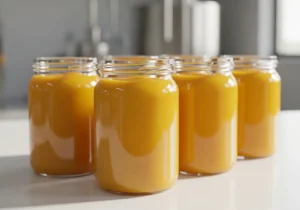
A fruit puree is neither thickened juice nor rehydrated concentrate: it is the edible, undiluted fraction of ripe fruit, disintegrated and sieved, and that definition shapes the plant floor. Indeed, it retains fiber, insoluble solids and aromas that juice pressing leaves behind.
In pineapple, it also contributes an intense yellow that holds up against dairy, coconut cream or ice. Moreover, this fruit ranks among the world’s top tropical crops by production volume, according to the agricultural production statistics of the United Nations Food and Agriculture Organization (FAO, 2024).
Single strength puree, NFC juice and concentrate
A single strength puree keeps its natural concentration inside the package: producers add no water and remove none either. In practice, its process route runs from fruit reception and selection through pulping, refining, pasteurization and aseptic filling.
NFC juice comes from extraction and partial clarification, so a good share of the pulp stays out. Concentrate, meanwhile, goes through evaporation to cut transport volume, at the expense of its aromas. The table below sums up what matters when you formulate a pineapple puree for cocktails.
| Criterion | Single strength puree |
NFC juice | Concentrate |
|---|---|---|---|
| Pulp content | High: sieved fruit | Low or none | Low, depending on reconstitution |
| Body in the drink | Creamy and stable | Light, tends to separate | Variable with dilution |
| Color contribution | Intense, uniform yellow | Translucent | Depends on the water added back |
| Water handling | No dilution, no evaporation | No concentration | Evaporation, then water replacement |
| Typical use | Creamy cocktails, frozen and RTD | Soft drinks and clear beverages | High-volume bases |
From juice to puree: what changes inside the glass
Above all, the clearest change happens in the mouth. A cocktail with pulp gains body, clings to the glass and holds the shaken foam, while juice alone turns watery once the ice yields.
The data sheet for our pineapple puree for cocktails reports 9.0 to 14.0 °Brix, pH 3.30 to 3.90 and acidity from 0.50 % to 0.80 % as citric acid. That range holds the drink together without added preservatives. Still, the measurable points are few.
- Aromatic intensity: the pulp retains volatiles that juice loses.
- Body and texture: insoluble solids deliver a creaminess unreachable with juice.
- Stability: viscosity reduces phase separation inside the bottle.
- Fruit content: without dilution, the label percentage climbs.
- Presentation: uniform yellow improves the image on the menu and in photos.
Overall, that combination pays off more when the recipe starts from the ingredient.

What to prepare with pineapple puree for cocktails
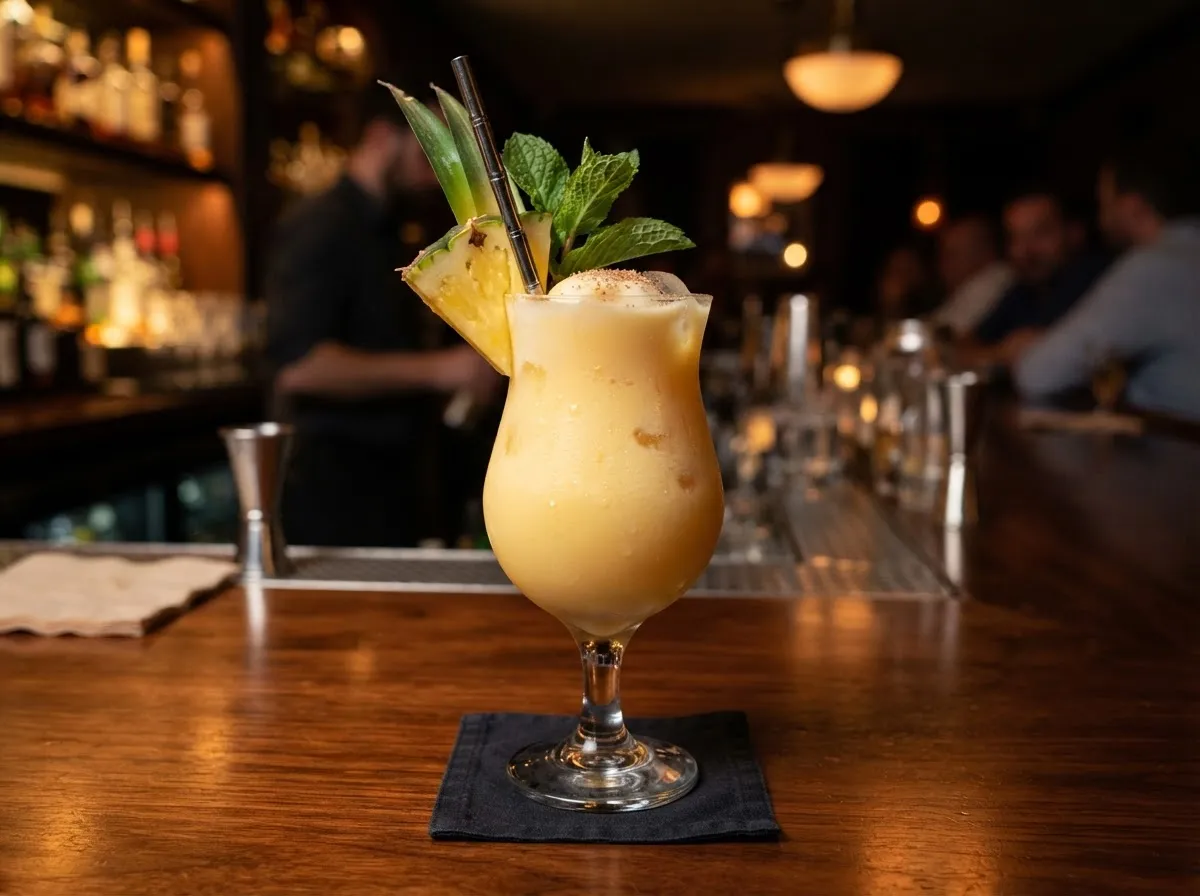
Naturally, pineapple supports both historic recipes and recent portfolio developments. It anchors the piña colada, where pulp gives the body coconut cream alone cannot reach, and appears in tropical margarita, daiquiri and mojito versions.
Similarly, fiber in frozen drinks keeps the mix from breaking once the ice yields. The question of what to do with pineapple puree admits different answers by channel, since manufacturers use one input for ready to drink lines, nectars and smoothies.
- Creamy builds: piña colada plus variants with coconut milk or yogurt.
- Citrus cocktails: tropical margarita, daiquiri and pineapple mojito.
- Punches and tikis: mai tai and rum punch for pitcher service.
- Alcohol-free: mocktails, flavored waters and tropical soft drinks.
- Smoothies: fruit bases with dairy or plant-based alternatives.
- RTD beverages: packaged formats that demand a constant profile across lots.
As for pairings, pineapple accepts company without losing its identity. It works with mango and passion fruit for tropical character, with coconut to round the texture and with lemon or orange for freshness; ginger and spearmint cut the sweetness.
Among spirits, rum remains the natural partner for pineapple puree for cocktails, while vodka leaves the fruit up front and tequila adds agave notes.
Consistency, costs and criteria for choosing a supplier
For a plant, the value of a puree lies not only in flavor but in the adjustment work it saves. In fact, an input with tight physicochemical ranges lets you fix a formula and hold it, lot after lot.
Consequently, that shortens preparation times, lowers rework waste and makes the jump from pilot to production predictable. It also simplifies research and development work, because prototypes compare cleanly without the noise the raw material introduces.
What to review in the technical data sheet before signing
A well-built data sheet answers almost every purchasing question before the first meeting. Ideally, you read it beside the formulation and the lot history, because every parameter weighs on the final recipe.
Degrees Brix define sweetness and the sugar adjustment on the plant floor; pH and acidity set microbiological stability. Color and texture, in turn, anticipate the look in the bottle, while shelf life drives logistics and inventory cost.
- Origin and traceability, with a lot code by date and packaging format.
- °Brix, pH and acidity ranges, with the declared test method.
- No additives, no preservatives, no added sugars.
- Formats: 220 kg or 230 kg aseptic drum and 20 kg box.
- Shelf life: 18 months in bag-in-box and 24 months at -18 °C or below.
- Current certifications and compliance in the destination market.
With that list, you evaluate the input like any other formula ingredient.
Frequently asked questions about pineapple puree for cocktails
Typically, questions repeat from one purchasing table to the next, and nearly all point to one issue: how interchangeable the puree is against approved-formula inputs.
The answers below sum up what technical evaluation usually raises, before anyone requests a sample.
- Can the puree replace juice in an existing recipe?
Pineapple puree for cocktails can replace it, though not at a one-to-one ratio. Because it carries more solids and less water, it asks for a dilution and sweetness adjustment you make only once.
- Does it contain added sugar?
It carries no added sugar. Specifically, the data sheet’s 8.26 g of sugars per 80 g serving come from the fruit, alongside 41 kcal and 1.1 g of fiber.
- Is it suitable for alcohol-free drinks, smoothies and frozen preparations?
Pineapple puree for cocktails works in all three cases: in mocktails it supplies the body a spirit usually gives, in smoothies it acts as a base without thickeners and in frozen drinks it limits phase separation.
Dream Foods: Colombian fruit ready for your next beverage line
Dream Foods Caribe produces tropical fruit purees and single strength juices from the La Cayena free trade zone in Barranquilla, with crops from Santander, Valle del Cauca, Risaralda and Quindío. Our pineapple puree is single strength, with no additives and no preservatives.
We ship the portfolio in 220 kg and 230 kg aseptic drums and 20 kg boxes, with KOSHER and FSSC 22000 certifications. For B2B projects requiring a pineapple puree for cocktails with a constant profile, support runs from sample to contract; if the development needs more acidity, single strength passion fruit puree follows the same route.
Write to us, request the sample and put Colombian fruit into your next formula.
References
- Food and Drug Administration. (2024). Title 21 CFR Part 120: Hazard analysis and critical control point (HACCP) systems. Electronic Code of Federal Regulations.
- Foundation FSSC. (2023). FSSC 22000 scheme version 6. Foundation FSSC.
- Organización de las Naciones Unidas para la Alimentación y la Agricultura. (2024). FAOSTAT: cultivos y productos de ganadería. FAO.
- Organización de las Naciones Unidas para la Alimentación y la Agricultura y Organización Mundial de la Salud. (2022). Codex Alimentarius: normas internacionales de los alimentos. FAO y OMS.