When you store it below 24 °C, aseptic pineapple puree can last up to 18 months in bag-in-box packaging. For this reason, it suits beverage, ice cream, and jam manufacturers who want to produce without relying on freezers.
This guide answers “what is pineapple puree,” explains how manufacturers make it, and covers what to check before buying. In addition, you will compare it with frozen puree and learn what to ask your supplier for a confident decision.
What does aseptic pineapple puree consist of?
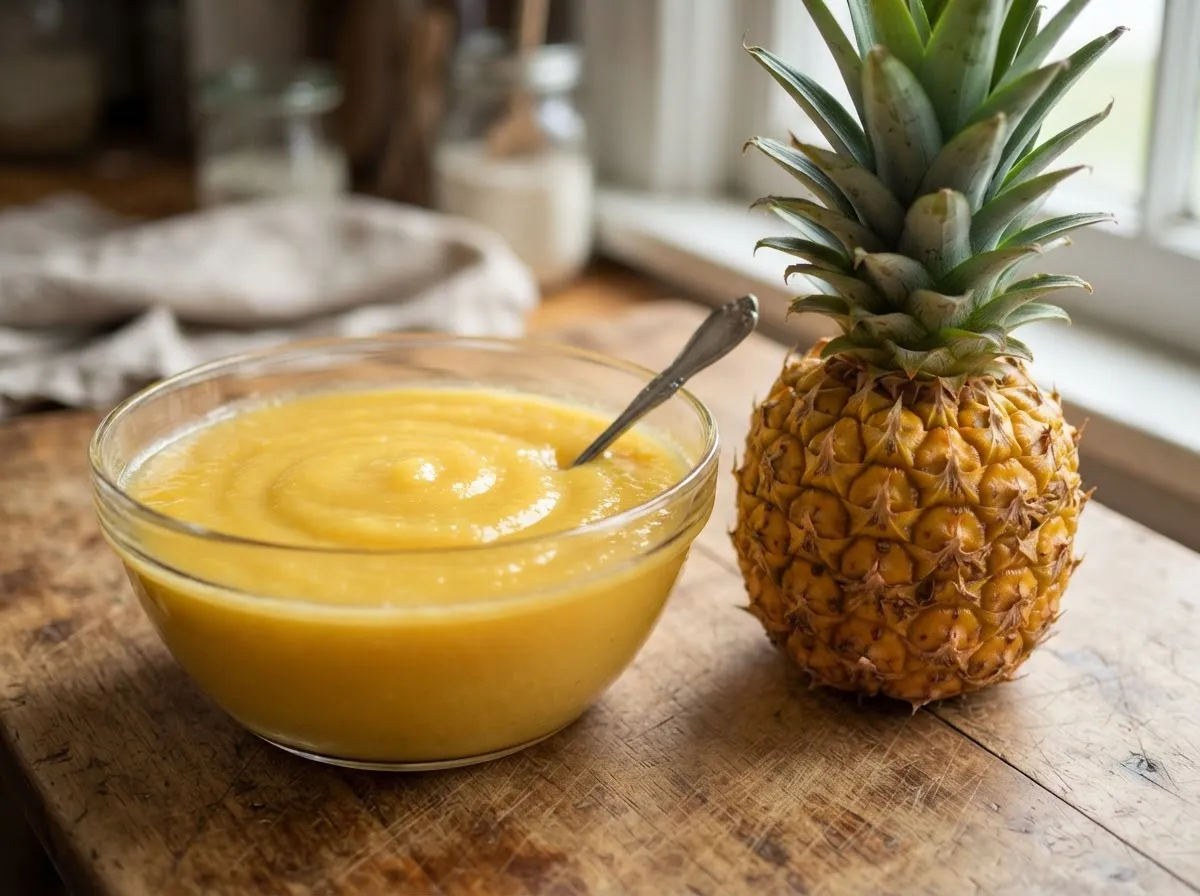
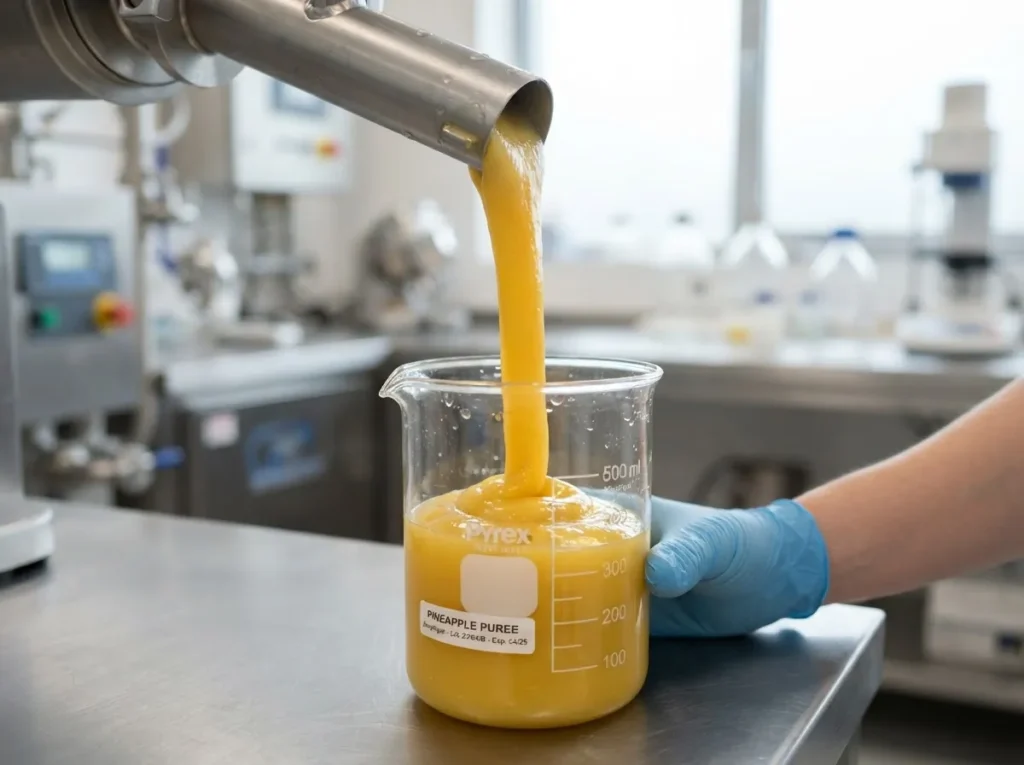
It is the edible part of ripe pineapple, which producers crush and sieve until it reaches a fluid, homogeneous texture. Afterward, the plant pasteurizes it and packs it under sterile conditions, so it needs no preservatives yet stays stable.
In short, it is an industrial ingredient that is ready to use on beverage and food production lines.
Specifically, the process for aseptic pineapple puree includes sorting, washing, sanitizing, pulping, refining, pasteurization, and aseptic filling. In other words, aseptic means that the treated product and sterile package come together in a microorganism-free environment.
Does it need refrigeration?
No, you can store aseptic pineapple puree at room temperature as long as the package remains closed. For example, high-barrier polyethylene bags last 8 months, while bag-in-box packaging reaches up to 18 months. However, once you open it, follow the manufacturer’s instructions and handle it as a perishable product.
What are the technical specifications of aseptic pineapple puree?
In general, the key specifications include Brix, pH, acidity, the microbiological profile, and the sensory characteristics of the product. Below are the values that our current technical data sheet reports, which are useful for comparison with your formulation:
| Specification | Dream Foods pineapple puree |
| Soluble solids at 20 °C | 9.0–14.0 °Brix |
| pH at 20 °C | 3.30–3.90 |
| Acidity | 0.50–0.80% as citric acid |
| Commercial sterility | No growth of aerobes or anaerobes |
| Pathogens | Absence of Salmonella sp. and L. monocytogenes |
| Color | Intense, uniform yellow |
| Aroma and flavor | Intense, characteristic of ripe pineapple |
| Texture | Fluid and homogeneous |
| Composition | Pineapple pulp, no additives or GMOs |
In addition, the product contains no allergens, and 0.6 mm filters control any foreign particles during processing. Furthermore, with a pH below 4.6, pineapple falls into the acid food category that U.S. regulations define.
Is it a single-strength puree?
Yes, our aseptic pineapple puree is single-strength, so it keeps the fruit’s solids without concentration or dilution.

A concentrate, on the other hand, loses water during processing, and manufacturers generally reconstitute it before use. For beverage manufacturers, therefore, the single-strength format saves dilution steps and keeps a flavor true to the fruit.
Aseptic pineapple puree vs. frozen: Which format suits you?
It depends on your infrastructure, since aseptic puree stays at room temperature, while frozen puree requires a cold chain. On the other hand, frozen puree offers a longer shelf life if your plant has freezer rooms. Accordingly, this comparison helps you decide with concrete data based on your storage and transportation conditions:
| Criterion | Aseptic | Frozen |
| Storage | Room temperature, below 24 °C in bag-in-box | Freezing at –18 °C or lower |
| Shelf life | 8 to 18 months, depending on packaging | Up to 24 months |
| Cold chain | Unnecessary while the package stays closed | Mandatory in storage and transport |
| Packaging | 220 or 230 kg drum and 20 kg box | 200 or 220 kg drum |
Overall, aseptic pineapple puree is the better fit if you want to simplify the logistics at your plant. In contrast, frozen puree makes sense when your operation already has freezer rooms and subzero transportation.
If you want to compare both formats on your line, request samples and technical specifications for our single-strength pineapple puree. With that information, your team can then validate yield, flavor, and storage before closing any purchase.
What benefits does this format offer in industrial production?
The greatest advantage of aseptic pineapple puree is its stability, which makes it ideal for planning purchases and production smoothly. In particular, these are the most relevant benefits for purchasing, quality, and research and development teams:
- Extended shelf life. As a result, you can store it for months without freezing, which helps reduce expiration losses in storage.
- Less dependence on the cold chain. Since it needs no freezing while the package stays closed, it lowers the energy use of refrigerated storage.
- Consistent quality. Likewise, the plant controls pH and pasteurization in every batch, two critical points that help maintain a uniform product.
- Simpler annual planning. Its stability makes it easier to schedule inventory throughout the year, although final supply depends on harvests and sourcing.
What can you use aseptic pineapple puree for?
It works as a fruit base in beverages, as well as in dairy, ice cream, jams, jellies, and compotes. If you are looking for pineapple puree for drinks, start with these applications and then explore other portfolio lines:
- Nectars and fruit drinks. Together with body and a yellow color, it adds a tropical flavor that blends well with other fruits.
- Smoothies, cocktails, and mocktails. Moreover, its fluid texture makes quick blending easier in ready-to-drink preparations or in beverage programs.
- Beers and flavored waters. It lets you add natural pineapple notes to craft beers and flavored waters instead of artificial flavorings.
- Dairy and ice cream. Manufacturers also add it to yogurts, dairy drinks, and ice cream bases that need real fruit and consistent flavor.
- Jams, jellies, and compotes. Finally, its acidity profile helps you balance the sweetness in fruit preserves and fruit fillings.
How do you choose an aseptic pineapple puree supplier?
Above all, choose a supplier that proves its quality with documents, not just promises, and that can sustain your volumes. To evaluate it methodically, we recommend following these steps before you sign a supply agreement:
- Review the technical specifications. First, compare Brix, pH, and acidity with the ranges in your formulation and quality control.
- Verify the certifications. Next, ask for current evidence of schemes such as FSSC 22000 or Kosher and of compliance with U.S. standards.
- Evaluate shelf life and storage. Then, confirm how many months each package lasts and what temperature it needs to preserve quality.
- Check traceability. Also, each drum or box should show the lot, dates, origin, and storage conditions on its label.
- Request samples and documentation. Finally, test the product on your line and ask for the data sheet, certificates of analysis, and allergen statement.
What should you ask the supplier before buying?
A good technical conversation saves you surprises at the plant, so bring these questions to your next meeting. In fact, the answers will tell you a lot about each manufacturer’s reliability and real capacity:
- What is the Brix and pH range? Thus, you confirm that the product fits your recipe without any additional sugar or acidity adjustments.
- Is it single strength? The answer tells you whether you need to dilute it, which changes your yield and cost calculations.
- Does it contain added sugar or preservatives? The answer defines how you will declare the ingredients on your label and on your final product’s data sheet.
- Can you send samples and supply in bulk? With this, you validate the product before scaling up and ensure continuity as your production grows.
What should you check when importing from Colombia?
When importing aseptic pineapple puree, review its origin, traceability, technical documentation, and compliance with U.S. standards. For example, our pineapple comes from Colombian regions such as Santander, Valle del Cauca, Risaralda, Cauca, and Quindío. Before you import, these are the points you should confirm with any Colombian supplier of processed fruit:
- Regulatory compliance. First, confirm that the manufacturer produces it under 21 CFR Part 117, FSMA, and the HACCP rules for juice.
- Technical documentation. Likewise, request the data sheet, certificates, and microbiological analyses for each lot to speed up your quality team’s review.
- Logistics and packaging. Also, choose formats that withstand long journeys, such as double-bag drums or boxes with aseptic bags.
Aseptic pineapple puree from Dream Foods
At Dream Foods, we produce pineapple puree in the La Cayena free trade zone in Barranquilla, using selected Colombian fruit. Our product is natural, single-strength, and preservative-free, and we develop it for U.S. food and beverage manufacturers.
Moreover, we offer it in industrial formats with technical documentation that adapts to different production volumes:
- Aseptic formats. These include 220 or 230 kg metal drums with double bags and 20 kg cartons with aseptic bags.
- Frozen format. Similarly, it comes in 200 or 220 kg metal drums with double polyethylene bags for plants that use cold storage.
- Food safety and certifications. We hold Kosher and FSSC 22000 certifications, and we comply with 21 CFR Part 117, FSMA, juice HACCP, and AIJN.
Request a quote for aseptic pineapple puree and receive samples and technical specifications to validate it on your line. Throughout the process, our team supports you with the documentation your quality department needs to approve the supplier.
References
- Buck Creek Distributing. (n.d.). Pineapple—Aseptic fruit puree.
- Fruit Purees Miami. (n.d.). 44 lb pineapple – Aseptic fruit puree.