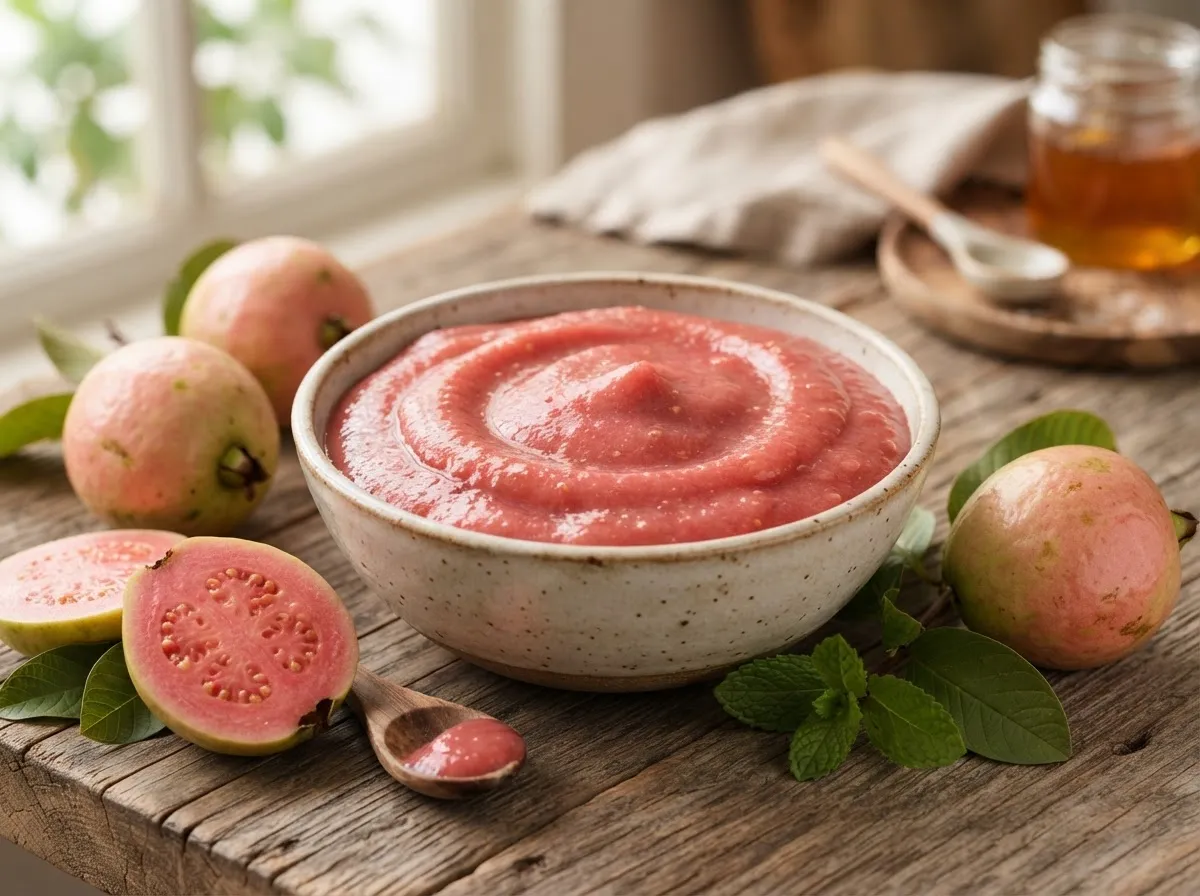
The processed pink guava puree provides color, acidity, and fruit consistency to beverage and industrial food lines. This soluble ingredient allows plants to process fresh fruit through sieving that separates seeds and fibrous residues. In particular, the Tropical Pink variety accounted for 46.71% of the global market for this ingredient in 2025 (Mordor Intelligence, 2026).
Technical departments analyze variables such as Brix levels, pH, titratable acidity, and microbiological counts before making purchasing decisions. In this way, modern plants favor standardized raw materials to maintain predictable operational performance during every shift.
What is pink guava puree used for in the industry?
It serves as a homogeneous fruit base that adds color, aroma, and acidity to nectars, functional beverages, dairy blends, and baked goods. At the same time, the beverage sector accounts for 53.6% of global demand due to the growing popularity of tropical profiles in supermarkets (Future Market Insights, 2026).
Factories address organoleptic variations by replacing whole fruit with stable liquid components in their mixing tanks. Many production managers seek to simplify their recipes without relying on synthetic colorants or heavy additives. For this reason, the technical alternative for formulating clean-label products is to source guava puree single strength.
Main applications in food and beverages
Industrial processing facilitates catalog diversification through fruit bases with stable texture. First, technical developers incorporate standardized raw materials into various continuous production areas:
- Beverages and nectars: provides natural turbidity and fruity aroma without heavy sediment.
- Dairy products and ice cream: provides firmness and color in yogurts or frozen desserts.
- Bakery and confectionery: retains moisture in baked fillings and toppings.
- Brewing and fermentation: adds fermentable sugars and citrus notes to craft beverages.
As a result, the use of pink guava puree optimizes yields in high-volume production plants. This physicochemical uniformity speeds up mixing times in closed reactors.
What distinguishes pink guava puree from conventional pulp?
The difference lies in mechanical sieving, as the puree removes woody residues and seeds to achieve a fine emulsion. In contrast, traditional pulps contain coarse fibers that clog dosing valves in automated continuous filling lines.
Concentrates require prior reconstitution with water at the plant, adding thermal steps to the process. Commercial classifications vary according to the supplier and the regulatory framework of each destination country. Therefore, quality departments audit the technical data sheet before authorizing any raw-material substitution.
Sensory attributes and texture behavior
The reddish tone of ripe fruit provides a distinctive visual color without chemical colorants. Certainly, the sector is projected to grow at an annual rate of 6.02% through 2032, driven by natural ingredients in commercial formulations (Fairfield Market Research, 2025).
Continuous sieving removes stony particles, allowing for a uniform texture on the consumer’s palate. Likewise, pink guava puree delivers balanced sweet-and-tart notes that pair well with citrus or full-fat dairy profiles. This fluid viscosity facilitates cold dosing without causing phase separation in finished bottles.
What technical parameters does pink guava puree require?
It primarily requires control of soluble solids between 8 and 11 °Brix, a pH of 3.50 to 4.20, and titratable acidity of 0.50% to 0.80%. Specifically, analysts verify these specifications in the laboratory before authorizing the shipment to enter the warehouse:
- Brix levels: quantifies natural sugars to calculate yield in syrups and beverages.
- pH level: affects chemical stability and the action of preservatives in the blend.
- Titratable acidity: defines the acidic profile against the natural sweetness of the crop.
- Viscosity: determines the pumping pressure required through sanitary piping.
- Microbiological control: rules out pathogenic bacteria, molds, and yeasts in processed batches.
Thus, analytical verification prevents deviations in the final flavor of each batch. This operational control supports the standards required by current sanitary audits.
Ingredient declaration and sugar control
The commercial name of a processed fruit does not mean that the ingredient is free of added sucrose. In reality, some presentations include artificial sweeteners or corn syrups that alter density and final caloric content. Buyers should review the ingredient list to avoid components that could prevent clean-label certifications.
Nevertheless, using pink guava puree with no added sugars facilitates compliance with regulations on nutritional warnings on commercial packaging. This transparency in formulation simplifies exports to markets with strict front-of-pack labeling requirements.
Does aseptic pink guava puree require refrigeration?
It does not require continuous refrigeration while the package remains sealed, because its thermal process provides stability at room temperature. In this regard, manufacturers evaluate deaeration treatments and thermal shock to preserve sensitive nutrients in the pulp (HTF Market Intelligence, 2026).
The frozen guava puree requires cold rooms at -18 °C to prevent microbiological damage during storage. The choice of system depends on the plant’s installed cold-storage capacity and monthly replenishment frequency. Likewise, Dream Foods Caribe supplies aseptic formats that reduce land-transport and warehousing costs.
Evaluation criteria for industrial purchasing
The selection of raw-material suppliers requires technical protocols that go beyond simple cost per kilogram. Generally, procurement departments structure their audits around the following operational control points:
- Origin traceability: identifies crops to validate uniform and safe agricultural practices.
- Food-safety certifications: verifies HACCP or FSSC 22000 standards at processing plants.
- Delivery formats: evaluates the use of 200 kg drums or medium-sized bags according to consumption.
- Laboratory testing: enables pilot samples to be tested before authorizing large purchase orders.
Indeed, sourcing pink guava puree under these technical parameters reduces unexpected plant downtime. This commercial discipline strengthens long-term relationships with qualified distributors.
Advantages of pink guava puree single strength
The single strength designation defines a natural base that maintains the original water ratio of the crop. Dream Foods Caribe processes this ingredient under parameters of 8 to 11 °Brix and titratable acidity of 0.50% to 0.80%.
For this reason, developers work with a raw material that does not require dilution with purified water in their tanks. This technical quality preserves volatile aromas and the natural pink color that the final customer recognizes on the shelf. Moreover, its homogeneous flow streamlines direct dosing into continuous reactors for beverages and dairy bases.
Consistency control and balance between batches
Ingredient standardization reduces seasonal variations in sweetness and acidity that affect production batches. In lines that alternate tropical fruits with frozen papaya puree, maintaining tight specifications prevents continuous reformulation of base recipes.
Undoubtedly, pink guava puree should have consistent viscosity ranges to prevent visual changes in nectar bottles. Analysts perform sensory evaluations and instrumental measurements before releasing each pallet to production. Consequently, this strict receiving control protects the organoleptic profile defined by the brand in the market.
Questions to ask the puree supplier about pink guava puree
Technical communication with the manufacturer clarifies analytical questions before scheduling high-volume shipments. To begin, quality teams should require supporting documentation to verify these operational aspects:
- Certificate of analysis: details the actual physicochemical values of the batch shipped from the factory.
- Packaging format: confirms the availability of aseptic bags or hermetically sealed metal drums.
- Shipping times: coordinates delivery deadlines to avoid inventory shortages at the factory.
- Sample availability: facilitates laboratory testing in the food matrix before the order.
As an example, beverages account for 42.5% of total consumption of this industrial product (DataIntelo, 2026). Requesting this technical information prevents incorrect purchases and speeds up raw-material approval.
Operational yield and waste reduction at the plant
The value of a processed ingredient lies in streamlining manufacturing times in high-volume facilities. Plants reduce operating costs by eliminating manual tasks such as selecting ripe fruit and removing peels.
In addition, the use of pink guava puree promotes rapid dispersion with hydrocolloids, sugars, and dairy bases in industrial mixers. Dream Foods Caribe processes raw materials under technical specifications that facilitate uniform batches every production day. Therefore, plant managers choose ready-to-dose ingredients that optimize labor efficiency.
Decide on the purchase of pink guava puree for your company
Selecting a processed-fruit supplier is a strategic decision for strengthening the competitiveness of your products. Having defined Brix, pH, and microbiological parameters simplifies the design of foods tailored to market demand. Consequently, processing companies move forward by requesting technical data sheets and coordinating pilot tests at their facilities.
Dream Foods Caribe provides specialized guidance and analytical samples to support the development of new commercial launches. In summary, an informed purchase strengthens plant efficiency and improves your business’s financial margin.
Referencias
- DataIntelo. (2026). Guava puree market research report 2034.
- Fairfield Market Research. (2025). Guava puree market: Global industry analysis, size, share, growth, trends, and forecast 2032. MarketResearch.com.
- Future Market Insights. (2026). Guava puree market.
- HTF Market Intelligence. (2026). Global guava puree market opportunities & growth trend to 2033.
- Mordor Intelligence. (2026). Guava puree market size, share & 2031 growth trends report.