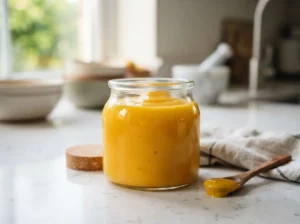
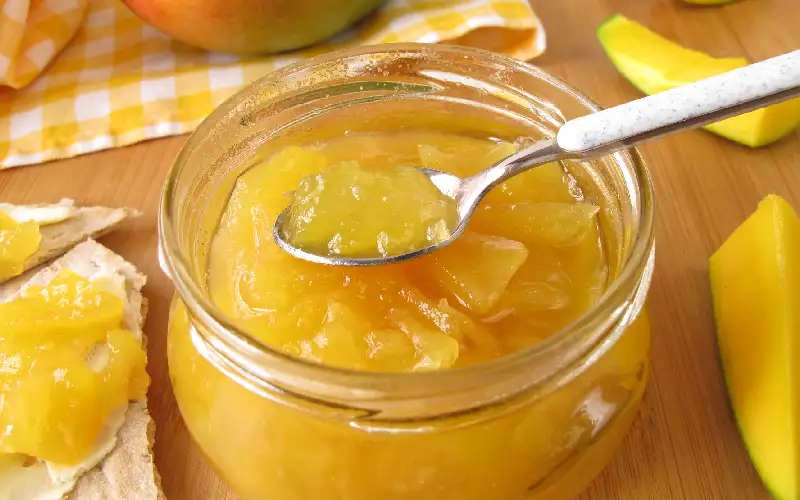

Mango jam is a sweet, spreadable product made by cooking mango with sugar, pectin, and an acid source until it forms a soft gel. Unlike clarified jellies, it keeps part of the fruit’s body, so the flavor stays close to ripe mango. For manufacturers, however, the real challenge is consistency. For that reason, this guide covers formulation, pectin, acidity, shelf life, and why mango puree simplifies large-scale production.
What is mango jam?
In short, it is a cooked blend of crushed or pureed mango, sweeteners and a gelling system. Because the fruit is not filtered out, the texture remains thick, spoonable and aromatic. That fruit-forward profile explains why bakeries, dairies and snack brands rely on it as a filling and topping.
Mango jam vs. mango jelly vs. mango preserves
Although these products look alike on the shelf, each one keeps a different amount of fruit structure:
- Jam: made with crushed fruit or puree, so it turns out smooth, thick, and intensely flavored.
- Jelly: made only with filtered juice; as a result, it sets clear and firm.
- Preserves: contain whole pieces or large chunks of fruit suspended in a soft syrup.
Consequently, ingredient choice changes with each format, and so do cooking times and pectin needs.
Main ingredients and how they work
Most commercial formulas balance four building blocks, along with optional flavor accents:
- Mango puree or pulp: supplies flavor, color, and soluble solids; in addition, a standardized mango puree offers the most predictable base.
- Sugar: adds sweetness and binds water, which supports both gelling and preservation.
- Pectin: the gelling agent responsible for a stable, sliceable texture.
- Lemon juice or citric acid: lowers the pH so the pectin network can form.
- Optional accents: ginger, passion fruit, chili, or coconut for differentiated lines.
Together, these inputs define how firm, bright, and shelf-stable the final mango jam will be.
Does mango jam need pectin?
In most cases, yes. Mango is naturally low in pectin, so a dependable mango jam almost always includes commercial pectin (MasterClass, 2026). Moreover, ripe mango tends to be low in acid, which weakens the gel even further.
Three variables decide whether the set forms correctly:
- Pectin type: high-methoxyl pectin requires high sugar levels, whereas low-methoxyl pectin gels with calcium in reduced-sugar formulas.
- Acidity: classic high-sugar systems set best near pH 2.8–3.5; hence the lemon juice or citric acid.
- Soluble solids: traditional formulas finish at 65 °Brix or more, the U.S. reference for standard fruit jams.
For low-sugar versions, formulators therefore change the pectin system rather than simply cutting sucrose; otherwise, the texture turns runny.
Mango puree, pulp, concentrate, or fresh fruit
The base ingredient defines cost, logistics, and final quality. Accordingly, this comparison helps purchasing and R&D teams decide:
| Ingredient | What it is | Best fit in jam production |
| Mango puree (single strength) | Refined, pasteurized fruit with nothing added or removed | Industrial lines that need batch-to-batch consistency |
| Mango pulp | Coarser fruit fraction, sometimes with visible pieces | Products that call for a chunkier, rustic texture |
| Mango concentrate | Puree with part of its natural water removed | Formulas that must boost solids or reduce freight |
| Fresh mango | Whole fruit that needs ripening, peeling, and processing | Small artisanal batches with flexible schedules |
For industrial production, aseptic puree is usually the most efficient route. In fact, it arrives ready to dose, with defined Brix, pH and color in every drum.
How mango jam is made in food manufacturing
At the plant scale, the process follows a controlled sequence rather than a kitchen recipe:
- Ingredient selection: teams specify puree with defined Brix, acidity, and color, plus the right pectin grade.
- Mixing and cooking: fruit, sugar, and pectin are blended, then cooked (often under vacuum) to protect flavor and color.
- Brix, pH, and texture control: in-line checks confirm target soluble solids and acidity before filling.
- Hot filling and quality checks: containers are filled hot, sealed, cooled and verified for seal integrity and microbiology.
Shelf life, meanwhile, is never a universal number; it depends on the formula, pH, soluble solids, thermal process, packaging, and validation studies.
Benefits of using mango puree in jam production
Compared with handling fresh fruit, an aseptic puree brings practical advantages to any jam line:
- Consistent tropical flavor and color, batch after batch.
- Smooth, uniform texture without peeling, pitting, or blending losses.
- Shorter prep time and less waste, because the fruit arrives ready to use.
- Better formulation control thanks to standardized Brix and acidity.
- Year-round availability, independent of harvest seasons.
Colombian mango keeps gaining ground in the United States: fresh shipments made their market debut in early 2023 (FreshFruitPortal, 2023). Likewise, varieties such as mango de azúcar are drawing attention for their natural sweetness (FreshFruitPortal, 2024).
Applications in bakery, dairy, and desserts
Beyond the breakfast jar, this ingredient performs across many categories:
- Bakery: fillings for pastries, thumbprint cookies, and layered mango cake.
- Dairy: yogurt bases, parfaits, and other chilled mango desserts.
- Frozen: ice cream ripples, sorbets, and novelty bars.
- Sauces and glazes: toppings for cheesecakes, pancakes, and even savory dishes.
In every case, a properly set mango jam holds its shape through baking, swirling, or freezing. That stability protects the look of the finished product.
Partner with Dream Foods
If your team is developing or reformulating a tropical line, Dream Foods can help. We produce aseptic mango puree and concentrate in Colombia under certified food-safety systems. Contact us to request technical data sheets and samples and bring the true flavor of Colombian mango to your next mango jam.
References
- FreshFruitPortal. (2023). Colombian fresh mangoes make U.S. market debut.
- FreshFruitPortal. (2024). Colombia’s mango de azúcar and its potential in the United States market.
- MasterClass. (2026). Mango jam recipe: How to make mango jam at home.
- Chef’s Resource. (2024). How to prepare mango jam?